
Who is Accountable for Accountability?

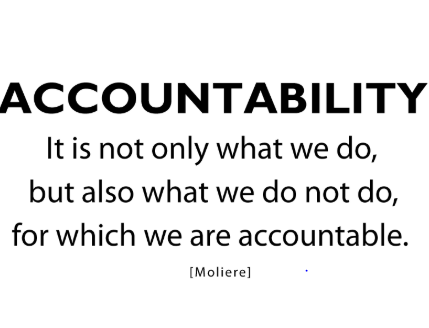
Accountability quote

We spend a lot of time in business talking about accountability.  Often the focus is other focused- how do we increase the team’s accountability? Why can’t that poor performer be more accountable? When will that partner/vendor improve their accountability? But instead of looking at the finger pointed at others, let’s think about the 3 fingers pointing back at us. As leaders, we are accountable for accountability. We do that by  modeling accountability, inviting accountability, and by expecting accountability.  Focusing on the actions and behaviors we need to do can move us from talking about accountability to creating it.

 Modeling accountability. The first step in accountability is for you as the leader to model it.  That begins with setting clear expectations. This starts with actually setting expectations. Does your team have clear objectives for each quarter? Where are they posted?  Have you shared your specific objectives for the quarter with the team? And your progress against them?  Research from Kaplan and Norton found that only 5% of the work force understand their organizational strategy. Not surprising given that their research also found 85% of executive teams spend less than one hour/ month discussing strategy.  Visual management is a simple and effective way to model accountability. Create a visual management board for your team- either a real board on a wall or a virtual one where you post the organizational goals, your leader’s goals, and your goals, and your teams’ specific objectives for this quarter. Start by focusing on your goals, and add a red, yellow, green box to show what progress you have made toward each of those goals. Update it weekly. Most importantly, be honest. It’s okay if you don’t have everything green- what you want to model is being transparent about results, openly discussing road blocks and challenges, and how to get back on track.  If you want others to be accountable, then they need to see that you are accountable – so make your accountability evident and open.

Inviting accountability. Think about what the end of the quarter looks like in your company. Do you/your leaders act like this quarter is the most important quarter in the history of the company- every quarter? Here is a list of the most common quarter end activities: Calling your team and reading them the sales results – even though they have the same report(s) you do.  Telling them you expect them to close the gap and then some, no excuses. Knowing their budget was unreasonable but driving them into the ground to meet it anyway. News flash: this does not create accountability, but it is a great breeding ground for resentment and disengagement. The word invite is intentional – you can’t force accountability and sustain great results. When people don’t buy into a plan and things head south, they jump off the race track and into the spectator seats. What you want to cultivate is a team who stays on the track and shifts into problem solving mode when they hit a speed bump. Inviting accountability forges a new road to results. Ask your team to create a quarterly plan that maps out what they will do to reach their key goals. Review them on a regular basis throughout the quarter. Shift the conversation by shifting your focus from the results (# new customers, satisfaction rating) to the inputs that drive those results. Ask questions about what’s working, what’s not working, and offer some coaching on what else they can do. End the session by asking them what specifically they will do before your next check in. And then at the next check in follow up to see what they’ve done. If people create a plan themselves, they are much more likely to be accountable to it. And you may just be surprised with the ideas they come up with.

Expecting Accountability. So let’s imagine that you have shared your goals and results with the team. You have created regular meetings to assess their progress toward their goals. And you see they are really trying. But one employee, Jim, is not consistently following through. He sort of works on his plan. He hits one or two of their goals. But he is more of a coaster than a go-getter. How you handle this will either cement or crack  your team’s commitment to accountability.  Accountability means everyone, for everything, all the time. Or it is meaningless.  Speak to Jim in clear terms about his performance, and the gap in his delivery.  Start with the facts: he committed on X date to Y deliverable, and to date you haven’t seen the results. Follow up with the impact: Because he has not completed Y, let him know the specific impact on his peers/customers/vendors. Then set the consequence. If Y is not done by Z date, he will be taken off the project. Given an unsatisfactory rating. Written up. Ask him to go back and update his plan with a new approach to hit the new date. End by asking what help he needs from you or others. Confirm his understanding and re-invite his commitment. If he doesn’t want to get on the bus, then work within a plan to get off it.  The team already knows Jim is not carrying his weight- and if you don’t do anything to address it, you risk losing both their accountability and their respect.

Being a leader means both enabling and expecting accountability. As the leader you assume accountability for the teams’ results. What you don’t want to do is assume that the team understands what it means to be accountable. Steven Covey says accountability breeds response-ability. You can drive accountability in your team and enhance their response-ability by modeling, inviting, and expecting accountability.




Spring Clean Your Mind

Spring cleaning

April usually brings thoughts of spring and renewal. Many of us have a ritual of spring cleaning – donating clothes the kids have outgrown and admitting we don’t need 6.5 pairs of scissors in one drawer. Spring is also a great time to bring a renewal mindset to our work. In the article Three Easy Ways to Spring Clean Your Work Life author Zameena Mejia says that we take in about 64B of information a day. This makes our brains feel like our hall closet- stuffed the the gills, no longer organized, and hard to open. It also makes it hard to be productive at work when we are in overload mode. Take the time to spring clean your mind by clearing clutter, creating focus, and having free space.

Clearing Clutter. Clutter can be both physical and mental. Start with the stuff that’s easy to see. Take a step back and think about how you would like to organize your work space. Give yourself permission to give away or throw away the books, papers, and even mementos you really don’t need anymore. Once you’ve made a dent in your office space try something radical – delete all emails over 30 days old from your inbox, sent, and deleted folders. Just do it. Freeing up that space is very liberating – and helps you to focus on the current tasks at hand. Learn some of the simple but awesome Microsoft Outlook rules to help you manage incoming emails more effectively. Now for the hard part. Clear the clutter from your mind. That project that didn’t go as well as you hoped. The nagging feeling you have that Pam in Payroll is upset with you. Make a list of the worries that are gnawing at you. Then crumple up the list and throw it away. Those worries are in the past. The question is, how do you want to move forward? You can choose to set up a meeting to check in with Pam. But if you don’t, then let it go. That issue no longer has a worry hanger in your mental closet.

Creating Focus. April means we are 25% through 2018. Have you accomplished 25% of your goals for the year? If not, how can you create more focus? Now is a good time to take out your annual goals and ask (1) Are these still the right priorities? (2) Am I making progress? (3) Where do I need to focus? One the best leadership tools I’ve picked up comes from the book The 12 Week Year. This book was written way before quarterly reviews became trendy. It challenges us to break our goals down into 12 weeks vs. 12 months. That means each week has more urgency to make progress towards your goals. It introduces a Periodization Plan to help you track and monitor your goals. I have been using this with my teams for the last ten years and it is a great tool to create focus.  Another key to mental focus is taking time to pause. If you are like me and love the idea of meditation but find it really hard to do, check out Buddhify. com. It is a great app for those of us who have a hard time slowing down. This is the most important step in your spring cleaning routine- so be sure to give focus some focus.

Creating Free Space. The only way to keep your spring cleaning stay clean is to ensure you don’t fill it with new clutter. In order for you to be your best self at work you need to have some downtime at home. Downtime is time when you are powered down and present. That may mean not working after dinner. Or not bringing phone in the bedroom. We all need some time of our day to be spent without a screen. We can also create free space by regaining control of our calendar. Instead of multitasking on a conference call, decline it and spend an hour focused on researching a key project. Block time on your calendar to read business and industry news. To be a leader we need time to think, not just do. Another great way to create free space is to work out. It doesn’t matter what you do or what level you are at. Engaging your body physically can unhook your mind and give you time to think about things in a new way.

I encourage you to make a commitment to spring clean your mind this month. It won’t make the MN snow melt, but it will help you with clearing clutter, creating focus, and having free space so you can spring ahead on your 2018 goals.


Encourage Courage

Courage Award

I was at the Good Leadership Breakfast this month, and the host was talking about an award that her family created – the Courage Award. It was a travelling trophy awarded to the family member that did something brave that week. I was struck by the power of that idea and started to imagine the impact of encouraging courage at work. Dictionary.com has three definitions of courage: (1) the power or quality of dealing with or facing danger, fear, pain, etc. (2) the courage of one’s convictions, the confidence to act in accordance with one’s beliefs. (3) take one’s courage in both hands, to nerve oneself to perform an action. There are some simple yet powerful things we can do in HR to encourage courage at work that will  help people face their fears, act confidently on their convictions, and take action.

Face Your Fear. Change in our personal and professional lives is a constant. So how can HR help our employees and leaders cope more effectively? It starts by acknowledging this reality. When working through a big change, like a spin off or layoff, or a smaller change, like a new benefit plan or PTO policy, talk about fear. Encourage people to discuss their concerns and worries, and help brainstorm solutions and options. Really listen to what you hear and be brave enough to respond. Be willing to change a plan or policy based on new information. Don’t be afraid of – or limited by – timelines and deadlines. Have the courage to do the right thing so that the project is done right.

Act on your convictions. Being an HR manager is a hard job. You wear a lot of hats ranging from coach, to project manager, to strategist. One of the most important hats you wear is as the conscience of the company. You have the unique position of hearing both what employees think and senior leaders are planning. And both parties are counting on you to serve as a bridge to the other. So listen, learn, and act. If you believe that the new values senior leaders are working on won’t resonate, speak up. If your gut says it’s the wrong time to launch an engagement survey, don’t do it. If you ever see sexist, racist, or otherwise disrespectful behavior or language – call it out. As Gloria Steinem said, “Whenever one person stands up and says this is wrong, it helps others to do the same.” Be the model of acting on your convictions for the organization – and help both employees and leaders learn how to follow your example.

Take Action. Franklin D. Roosevelt said, “Courage is not the absence of fear, but rather the assessment that something else is more important than fear.” A powerful way that HR can take courage “in both hands” is to focus less on communication change plans and more on change action plans. Work with teams to understand what is important to them. What actions help them achieve or preserve those things? How will they measure their progress? Celebrate their success? It is easy to have a talking head, senior leader video tell the organization about the benefits of a big change. It is impactful to understand the WIIFM from the employee and managers’ point of view and to help them to take action to achieve what’s in it for them.

The third Tuesday of October is National Face Your Fears Day. Consider making this an event in your workplace. Ask people to share how they overcame a fear or to discuss a fear they are struggling with. Create a Courage Award that you give every October to encourage courage at your workplace. But don’t stop there. Remember that courage is composed of big and small things every day. Most of the time these acts are invisible, but it’s time we shine a light on these examples. There are some simple yet powerful things we can do in HR to encourage courage at work that will  help people face their fears,  act confidently on their convictions, and to take action.


Rock and Role Rock Star Leadership

Rockstar blog

Great bands – and great teams- are composed of talented individuals collaborating to make something new and exciting together. As part of our new leadership curriculum at Abra we have designed a Rock and Role Rock Star Leadership module to help our leaders rock productivity and retention in their centers. We believe that good leaders want to rock results by focusing on key priorities, that teams with clear roles drive productivity, and that real rock stars build all star teams.

I wanna rock. Employees want to jam with the best, earn the applause, and collaborate on creating hits for the business. But before we are ready to perform we need to know our playlist. Rock star leaders help their team focus on priorities by identifying the big rocks and eliminating the gravel. Big rocks are the things that are important, but likely not urgent. They are the long term, strategic projects that will have a direct impact to the business. They are the things we know we should do, what we want to find time to do, but often don’t prioritize because we are drowning in gravel. Gravel is the thousands of small tasks like emails, meetings, or conference calls that can fill your calendar, but don’t fill your bucket and definitely don’t fill the stadium with fans. Rock star leaders help teams separate what is important from what is urgent, and work with the team to create clear priorities and areas of focus. They recognize that to do that we need to clear the gravel. Rock stars give the team permission to start new riffs, and to stop old habits. They remind us just because we always used to do X doesn’t mean we should still be doing X. They ask what we can automate and eliminate so that their team can rock.

Role With it Baby. Once you have the big rocks identified, a rock star leader now looks at where the work should get done. Some leaders think their job is to own every big rock themselves. But organizations don’t need one man bands, they need well- tuned teams. Teams can rock and roll when they have clear roles, use their strengths, and have on-the-job development opportunities. One role of the leader is to sort that gravel to determine if there are some diamonds in the rough that should be done, but should be done differently or at a different level or by a different team. In my earlier blog,  Improve Through Improv,  I talked about the magic teams make when they leverage team members’ individual strengths to collectively create the best outcomes. Teams have a lot of different roles, and a rock star leader looks at how to train the drummer on keyboards, and encourages the bassist to try a solo. This approach provides cross training and succession planning. It also brings new eyes to each role and empowers each person to roll with new and innovative approaches.

Baby I’m a Star. Plenty of bands have split because the lead singer demanded artistic control and tried to keep the spotlight on him/herself. A rock star leader doesn’t want credit – they want collaboration. They also know that to create that collaborative environment they have to focus on both short and long term results. They know that today’s hits won’t stay on the charts. They invest time finding and growing their future stars. They push their rising stars to test and try new ideas. They build all-star teams that deliver bold solutions. Rock star leaders give credit where its due, cover when it’s needed, and trust freely.

Leadership isn’t an easy job, but it should be a fun one – and one that we should make more fun, more rebellious, and more edgy. Kind of like a rock star. Wild make up and leather jackets optional. What’s required to be a Rock and Role Rock Star Leader is to  rock results by focusing on key priorities, that teams with clear roles drive results, and that real rock stars build all star teams.


50 books by 50

reader-tomorrow-a-leader (1)

I have always loved to read. I was “that kid” who took her book with her everywhere –reading on the bus, in the doctors office, at the dinner table. Today I still love to read but struggle to find time to read and feel torn between reading for work and reading for pleasure. Apparently I am not the only one struggling with this. According to a recent LinkedIn post by Amit Somani only .5% of people in the world read more than 3-5 books a year. So I decided to set a goal to read 50 books by age 50. That means I will need to double my reading rate and sustain it for two years. How I am going to do that? Good question! Here are some of the tips I plan to employ -and how it relates to leadership: Decide what supports the goal, learn from others, and follow your passion.

What supports the goal. Most of us have worked at a company with a WIG (wildly important goal) that was something like double sales by 2020 or increase our customer base by 30%. Aspirations are great but without clear plans to support them, won’t be more than a bumper sticker slogan.  With any kind of goal it is helpful to ask questions like these, from the Huffington Post article 5 Leadership Goals:

  • What have we tried to achieve in 2017 that we must accomplish in 2018, and how will that be rewarding to you (and your team)?
  • What targets are we hitting — and which ones are we missing due to our own actions as executives?
  • Is there anything I can do to get out of the way of — and, indeed, accelerate — our success?

These questions are insightful whether you are trying to improve quality, reduce turnover, or increase your reading. In my case, reading is rewarding, so what I will accomplish this year is setting a target of reading at least 20 pages everyday. I will accelerate my success by setting a firm bed time and creating a routine of reading every night before I go to sleep.

Learn from others. Whatever goal we are trying to achieve, we can pick up ideas and insights from others. I currently have over 500 books on my Amazon reading list. So one way to prioritize those books is to see what others recommend as their top reads. President Obama posted his reading list, as did Daniel Pink, Richard Branson, and hundreds of other thought leaders. Pick one or two that you already know and love and challenge yourself to follow the recommendations of someone outside of your normal go to group. Share your challenge internally and find out what your peers/other functions are doing that relates to your goal. My internal inquiries led me to read Lean Turnaround and  Four Disciplines of Execution  as my first two books this year. Ironically by starting with a discussion about Four Disciplines, I am now leading a training session on 5 Choices,  and am collaborating with senior leaders on our shared priority of driving productivity through improved people leadership.

Follow your passion. I love the quote, “If it is important to you, you will find a way. If  not, you will find an excuse.” That definitely applies to me and the goals I set for working out, at work, and now reading. The gap isn’t really time- we all have 24 hours in a day. It’s how we use and prioritize our time. Goals that ignite us are easy – creating a new leadership program, developing the acquisition strategy, defining a new customer segment. Goals that are outside of our expertise and interest are usually the ones that we keep deferring. In my earlier post Improve Through Improv I talked about tapping into- and trusting- the talents of the team to achieve your goals. Leveraging people’s strengths and passions is a natural accelerator.  So in my quest to read 50 books by 50 I give myself permission to pass on the books that don’t fuel my fire, to quit the books that aren’t engaging me, and to seek books that are aligned with my personal and professional passions.

Rachel Anders said, “The journey of a lifetime starts with the turning of a page.” Whether you are reading or on the journey to achieving a different goal, deciding what supports the goal, learning from others, and following your passion will help you get to your destination more quickly, and make it a more enjoyable ride.

SKOL Leadership


Vikings win

What. A. Game. I live in Minnesota and while I am a Packer fan, for the last minute and a half of Sunday’s playoff game I was sweating purple. This miracle finish was just the latest chapter in a miraculous season. After losing their starting quarterback and starting running back in the opening weeks, somehow the Vikings, led by their third quarterback, Case Keenum, and their defense pulled the team together. Not only have they stayed together, they ended the regular season with the second-best record in the NFC.  As I watched the game I thought, this is an awesome leadership moment in motion. The Vikings showed how teamwork, strategy, and persistence are what it takes to lead and to win.

Teamwork. Good teams work together and come together, especially under times of stress. Great teams are clear on their goal and commit to their specific role in helping the team achieve it. In the Harvard Business School article The Biggest Mistake You (Probably) Make With Teams, author Tammy Erickson gives the analogy of an emergency room, and writes,  “Before the next ambulance arrives, they have no idea of the nature of the task ahead. Will the patient require surgery, heart resuscitation, medications? The condition of the next patient is unknown; the tasks that will be required of the team, ambiguous. But at no time while the team waits, do they negotiate roles: “Who would like to administer the anesthesia? Who will set out the instruments? Who will make key decisions?” Each role is clear. As a result, when the patient arrives, the team is able to move quickly into action. The Vikings acted surgically – each person focused on exactly what had to happen on that last play so the patient- in this case their playoff dreams- had a chance of surviving. In her research, Erickson found that the most successful leaders ensure roles and responsibilities are clearly defined, everyone understands the project’s importance and ultimate objective, and the team is empowered to determine how to achieve their agreed to “what.” So help your team be great by setting clear goals and roles, and empowering and encouraging them to determine how to win.

Strategy. In football the coach can’t take over the various roles on the team, but off the field ask yourself, am I trying to be the quarterback, running back, and wide receiver or am I the coach? Mike Zimmer’s role was to create a strategy, make sure the team knew how to execute the strategy, and to build their confidence so that they could achieve their goal. Leaders don’t win games- they build teams that win games. In the article Doing Less, Leading More, author Ed Batista writes that many leaders believe if we work longer, harder, and smarter than our team, we’ll inspire by example. But he cautions that if you lead like a “Doer-in-Chief” you can’t pivot your teams from fire fighters to fire marshals. In Sunday’s game, it was evident that Zimmer had instilled a fire marshall mentality in the team – don’t panic when the heat is turned up, focus on execution. We can do the same in our roles with our teams if we do less, lead more, and stay focused on our strategy.

Persistence. Let’s not forget, the Vikings were not only down by 1 with 23 seconds on the clock. They have been down similar roads before. The Vikings have lost their last five NFC Championship games and lost four Super bowls. None of this is lost on the Vikings or their fans, nor is the fact that Minnesota is hosting the Super bowl in just 4 weeks. In the article Never Quit: Strategies on Perseverance From 6 Seasoned Entrepreneurs, entrepreneurs share what it takes to be persistent. The willingness to “take the hit.” Lead confidently, think big, and influence your outcome. As entrepreneur Roy McDonald says, “You can influence the outcome with the power of thought and intention. It’s important to focus on what you do want, instead of what you don’t want.” That mental toughness, or Grit as Angela Duckworth would say, is all about what goes through your head when you fall down, and how that—not talent or luck—makes all the difference in a person’s success.

In football and as a leader you want a team with strong teamwork, strategy, and persistence. Even before Diggs’ touchdown, the Vikings had to stretch their bench to get the right people on the field. They had to ensure everyone understood the playbook. They had to make big plays to be up 17-0, they had to have grit after the Saints came out with 17 unanswered points and they really had to dig deep when they were down in the last 23 seconds of the game. Their success- and the success of strong business teams– comes from knowing the plan, and committing to execute the plan. It means having a leader who clears the path and empowers the team. It also means having an unwavering belief that you will achieve your goal. I encourage you to think with SKOL leadership so you can see and celebrate your  team’s success.

Resolve, Go Solve, Absolve

New Years Resolution

Happy 2018! It is that time of year where think about our goals for the new year. We purchase new gear and goodies to help us reach that illustrious goal. Yet despite our initial anticipation, 22% of new years’s resolutions fail after one week, 40% after one month, and 50% after three months. How can you buck the odds this year and make your resolution a reality? There are three actions you’ll need to take: resolve, go solve, and absolve.

Resolve. It’s easy to look at these statistics and think why bother. But the very act of making a resolution matters. Setting a goal means you’ve identified something you want to strive for.  One key to a successful resolution is picking something important to you that are passionate about. You may feel pressure to climb the corporate ladder but if you love your current job, resolve to deepen your skills instead of getting promoted. The next step is to take that goal and make it a plan.  Think about how you will deepen your skills by doing X by Y date. Setting specific, measurable goals makes your resolution more tangible and therefore more achievable.

Go Solve. “Ideas are easy. Implementation is hard.” This is a famous quote from Guy Kawasaki, a former Apple executive and entrepreneur. Once you have your idea and your plan, ask yourself, have I gotten this far before? What got in my way? If you resolved last year to deepen your skills by getting your MBA but fell short because you didn’t have the time or money to make it happen, is that the right goal for 2018? Unless your financial or time commitments have shifted the likely answer is no. So how else could you solve for that? Could you take one class online? Could you learn new skills at work? Find a mentor? The specific solution is less important than finding a solution you can implement. Creating realistic momentum helps get you out of the gates and gets that idea into motion.

Absolve. Merriam Webster’s definition of absolve is to “to free from guilt or blame.” This is a crucial part of resolutions. We know that half of resolutions fail in the first six months. Yet we fail to plan for failure.  I love the blog  The Tiny Buddha by Leo Babauta, and in this post Babauta challenges us to relook at our expectations for building a new habit. He wisely says, “What if the problem is our hope that we’ll never have to get disrupted, that things will always go perfectly? This hope is, of course, greatly misguided. Things don’t ever go smoothly, progress is never linear, and we’ll always get disrupted….what we need to do is get good at starting, then starting again.” Absolve yourself from the guilt that you didn’t sign up for that online class yet. Absolve yourself from blame that you haven’t found a mentor. It’s never too late to restart. Just go back to solving again. Take any step- no matter how small- to regain momentum and look forwards, not backwards.

So break out your new 2018 calendar or journal, and think about what goal excites you for this year.  Write down some specific steps you can take to achieve that goal. Start doing – try anything, just start. Then prepare to restart. Approach 2018 with a resolve, go solve, absolve attitude and it will be a very happy new year.


Tweet Your Vibe

Tweet

“Tis the time of year to be thankful. To be generous. It is also a good time of year to think about the vibe we put out into the universe – both the physical and online space we occupy. Thanks to Catherine Byers Breet for sharing this photo and this article. It got me thinking that we all should be thinking, what’s my Tweet, how do I Tweet others, and why we should Tweet each other better.

What’s My Tweet? In the 7 Habits Of Highly Effective People, Stephen Covey’s second habit is to begin with the end in mind. In this chapter he asks the reader to imagine their literal end. Picture yourself at your funeral. What are people saying about you? What impression did you leave? A slightly more updated question is, if your family, friends, and coworkers were to describe you in 160 characters, what would they say? You may also want to check what have they said about you on social media. We all create a vibe- all we can control is if it is intentional or unintentional. What would you like your headline to be? With that end in mind, think about how you treat others, and make an intentional effort to live up to your ideal self.

How do I Tweet Others? The 7 Habits also encourage us to synergize. This means to believe that 1+1 is 3 and that by treating each other with respect and listening to different opinions we can come up with the best solutions. In today’s digital world it is easy with the quick stroke of the keyboard to criticize those we don’t agree with. The golden rule should apply both our physical and online communities – and is part of keeping a positive vibe. Being mindful is also key when interacting with our teams. We are so busy doing that we leave little time for connecting, engaging, and encouraging our employees. How we “tweet” them comes out in all the micro decisions we make -to say hi, to be present, to show genuine interest. These micro decisions can have a macro ripple.  Your words and your impact will be how your team “tweets” about you as they talk about their day with friends and family.

Why we should Tweet each other better.  In an earlier post, Connecting vs. Networking, I talked about the the power of connection, collaboration, and conscientiousness. In this day and age it is only a matter of when- not if- we lose our job, are acquired, or experience a major reorganization. When you need help guiding new terrain, who will be there for you? Who were you there for when they asked you for help? We live in a big small world. Put your positive vibe out there and help to Tweet someone’s story and skills. Create the positive energy needed to propel each other forward.

What we say and do – in person and online- matters. It creates a vibe that either fuels or flushes their energy. There are over a 160 ways a day we can be intentional about showing up as our best self. The best gift we can give ourselves and others is to be mindful about what’s our Tweet, how we Tweet others, and Tweeting each other better.


Math (vs Change) Management


Overwhelmed

I recently got to hear Nick Tasler  speak at an author’s breakfast. Nick is the author of great books like Ricochet and Domino about change management. My takeaway from his talk was that the real change we need is math management. There are a finite number of hours in the day. Within those hours humans require sleep and food to live. We need social interaction to be alive. These are realities. In my last blog post, I talked about embracing constraints instead of fighting or denying them. So let’s focus on the math management instead of change management. How can we divide our time, multiply our impact, and add uncertainty to support organizational change?

Divide (not dilute) your time. This is a key distinction. Many of us have diluted our attention across many different priorities, working on many things but making progress on few. So let’s take a new approach to this math problem. In Tasler’s book Domino he asserts that a key to change is identifying your top three priorities. Next you need to review your projects and divide them into two lists: a 90 day sprint – items that accelerate your top three priorities — and those that will have to wait. By time boxing your projects and focusing on what is tightly aligned to your priorities, you and your team will be able to focus and make meaningful progress on your most important initiatives. You will allow your team to give these priorities their undivided attention, and the dividend is that they can invest their discretionary effort into the change effort.

Multiplying (by magnifying) your impact. Southwest Airlines was the pioneer of the low cost airline business model. Today, 47 years later, they are the largest low cost domestic airline and have the second largest market share by revenue passenger miles. How did this upstart airline create and sustain such a change in the airline industry? Through their laser focus on their purpose: to connect people to what’s important in their lives through friendly, reliable, and low-cost air travel. Every decision they make as an organization is held up to this magnifying lens. When the marketing team was researching how Southwest could differentiate itself from the competition, one team suggested offering free meals on short, but popular flights. The executive team reviewed the proposal and decided it may be friendly, but it didn’t drive reliability or lower costs, so turned down the proposal. When a different group pitched allowing two free checked bags, the same decision process was used– friendly? Yes. Reliable? Sure. Low cost? Definitely. This differentiation hit on multiple elements of their core strategy and magnified their position as friendly AND low cost. What is your company’s purpose? How will your proposed change magnify your purpose and multiply your impact?

Adding (by addressing) uncertainty. The good news is you don’t actually have to add the uncertainty. You just have to honestly address it. Kurt Lewin created the three stage theory of change, commonly referred to as Unfreeze, Change, Freeze. The challenges today is that change is happening so fast we never get back to freeze and instead have to live in a state of slush. So when your team asks, “When will the change be over? Will there be more changes to come? How can we master this change before the next one comes?”, tell them never, yes, and unlikely. This may add uncertainty but it also adds honesty.  The next discussion you can have with them is, given that we live is a new state of slush, how do we navigate effectively? What should we let float by and what needs to crystallize? It is perfectly natural to seek solid footing in times of change, and it is highly unlikely to find it. Help your team navigate this tension by acknowledging and addressing it’s presence.

Abraham Lincoln once said, “If I had six hours to cut down a tree, I’d spend the first three sharpening my ax.” Unfortunately many organizations today have abandoned the idea of sharpening the saw, and instead reward a mass machete approach to change. Given that 70% of change initiatives fail, perhaps we need to take a step back and try a new approach. Don’t ask your team to power through a change. Instead empower them to create realistic plans that divide their time, multiply their impact, and add uncertainty so they can support your organization’s change priorities.


Embrace Constraints

think-outside-the-box

Our lives are full of constraints of all shapes and sizes. From taking conference calls while dropping off kids, to making dinner with what’s in the fridge, to juggling multiple work projects, we are all constantly balancing our limited time, resources, and scope. We often talk about these three interconnected constraints in project management — changing one impacts the other two. But what if instead of talking about these factors as constraints we think about them as accelerators? In his post How Constraints Fuel Innovation Instead of Restricting It, Vishal Kataria tells the story of how Toyota broke into the luxury car market. Their chief engineer challenged the team to build a car with a top speed of 155 miles per hour, an efficiency of 22.5 miles per gallon, a cabin noise level of 58 decibels at 60 mph, an aerodynamic drag of 0.29 or less, weighing less than 3800 pounds. None of their competitors had cracked one, let alone all five, of these goals. At first this seemed to be an impossible goal. But when the team designed to meet all these collective (and sometimes conflicting) constraints, they created the Lexus LS400, which outrated the BMW 735i and Mercedes 420SEL in every category rated by Car and Driver Magazine. And for $30,000 less.  Constraints can help you accelerate your productivity if you think outside the time, resources, and scope “box.”

Time: Think of less as more. Deadlines are stressful. And companies are infamous for short changing time to meet an executive’s schedule or demand. So embrace it.  According to a recent article cited in the New York Times, the average employee admits to spending 2 hours a day on non-work related tasks. So whatever timeline you thought you had, you really had 25% less anyway.  Help focus your team with more frequent, shorter meetings. You will have a different level of energy if you hold four 30-minute meetings rather than one two-hour meeting. Tell the team when the meeting ends, that phase of the process is done. Tell them in the first 30 minutes we need to complete X so that next time we can start with Y. Creating focus and urgency can up productivity– remember cramming for your college exams? Test it out and see what new results you see.

Resources: Look for the double down. There are never enough people or money for any given project. I am currently a department of one designing the learning and talent strategy for a production driven company. I am short on time and money and so are our leaders and team members. We have limited processes or practices to build off of. Isn’t that great? Now I get to focus on bite-sized learning, as I discussed in my Refresh Your Talent Menu blog, and to ensure that each piece we decide is intentionally interconnected. I am currently partnering with one of my peers to repackage some of our customer service training as coaching training. After all, asking questions, listening, and staying calm under pressure are key skills for working with customers and employees. And by using the same concepts in both scenarios we hope to ingrain them in our leaders.

Scope: Look through a new lens. Who decides what is in scope or out of scope for a project? Very rarely is it the end user. Lets say, for example, that your company is working on an acquisition. Your hands are more than full working on onboarding and talent assessment for the new employees. You don’t have the time or resources to address what is happening in payroll. You are in HR. But ask the average employee what HR does and they are likely things like payroll and benefits – because those are transactions that impact them in a tangible way, on a regular basis, and they don’t care what function that department sits in. So before deciding what is in scope, take a step back and think about what your employees are looking for. Design your project plans around that.

Think about Apollo 13. The constraints faced by that team were unimaginable – NASA had precious few hours to figure out how to return a severely damaged aircraft to earth using only the supplies the astronauts had on board. But everyone came together and came up with an ingenious, lifesaving solution. So how can you accelerate your productivity by embracing your constraints? Take a fresh look at the time, resources, and scope elements of your current project.  As Jeff Bezos said, “Constraints drive innovation. One of the only ways to get out of a tight box is to invent your way out.”