Are You Giver or Taker?

Giveandtake

If you were looking to hire a venture capitalist, what skills would you look for? I looked up a posting at Deutsche Telecom and they are looking for someone who is a “motivated and an enthusiastic self-starter who works on your own initiative….Confident and capable of easily interacting with senior management.” According to the book Give and Take -Why Helping Others Drives Our Success by Adam Grant, Deutsche Telecom is missing the most important quality for this competitive job: they should be looking for a giver.

Givers are people who believe that we go further together. They help others and put others’ needs as a priority. They don’t see relationships as a zero-sum game. They instead passionately believe we can all win together. In Grant’s book he highlights David Hornik, a venture capitalist who invites his rivals to hear pitches, responds personally to emails for investment requests, and will introduce entrepreneurs to his competitors. Hornik has also only lost three deals in eleven years. Hornik and others featured in Grant’s book challenge our paradigm of what it takes to get ahead in the workplace. In our increasingly interdependent, global, matrixed world it is important to self reflect and ask, am I giving or taking to get ahead at work?  Three key takeaways for me from this book are networking is not about you, check your credit score, and the impact of women givers.

Networking is not about you. Many people hate networking and see it as the ultimate taker activity, believing people build good networks to build their popularity. But as I referenced in a recent post, there is a big difference between connecting vs. networking. Networking is an opportunity to connect and help. Matchers see networking as a means to connect – but focus on reciprocating behavior. If you link in to a Matcher and ask for an introduction to someone in their network and offer to connect them to a key business leaders, he/she will gladly help you– once they’ve met that business leader. Givers know that we live in a small world and are motivated to improve the lives of those they are connected to. They gladly share their time, connections, and ideas and, as Grant says, “create norms that favor adding rather than trading value.” Step back and ask yourself, “Who have I helped lately, and what motivated me to do so?” Then think about someone from a past job and reach out and ask how you can help him/her. No strings attached.

Check your credit score. Jonas Salk is known as an international hero. In 1952 his research lab created a polio vaccine, and within two years of its release the rate of polio in the US fell by 90 percent. But Salk had a serious flaw– he was a taker. At a press conference held to recognize this enormous accomplishment, he did not recognize any of his peers. He failed to mention any of his collaborators, team members, or co-workers who contributed to this life changing event. Salk fell prey to responsibility bias, focusing on the time and effort he spent in the lab instead of seeing the team’s collective contributions. The key to a good credit score is not to keep score.  Instead, whenever your team has a big accomplishment, reflect first on other’s contributions and acknowledge them before mentioning your role on the project.

The Impact of Women Givers. Grant does not spend much time on the gender dynamic in this book, but as a working mother I had some immediate reactions to the giving/taking continuum. Women are raised to be givers, and our societal norms value women who are warm and nurturing. Grant’s research shows that givers face a tricky path — givers are statistically least likely to get ahead — giving credence to the idea that good guys finish last. But his research also shows that givers also finish first-they have the highest productivity, performance results, and revenue generation in their companies. The difference is givers who are “not selfless but are otherish.” Givers who are selfless often find themselves overwhelmed and over committed. But givers who focus on giving without losing sight of their interests are “Otherish.” They give graciously without overextending themselves. Women givers, and all givers, can increase their chance of success- and decrease their risk of burnout- by tuning into this key concept. The good news for givers is that the prototype of the successful leader is drastically shifting. According to a management survey of over 3,600 participants, givers have historically have had lower salary increases, slower advancement, and lower promotion rates. Less than 65% of givers were promoted to management roles compared to 83% of takers and 82% of matchers. This appears to align to our traditional stereotype that good leaders get ahead because of their (individual) hard work, talent, and knowledge. But that is shifting. Google recently used it’s data analytic prowess to determine the most important traits of effective leaders. The top three traits are a good coach, empower the team, and is interested/concerned with their team members’ success. Sound like an otherish giver? Good news for givers and for women givers if these traits are now seen as strengths instead of risks.

We all are part giver, matcher, and taker. You can find out your rating at Adam Grant’s website.  Grant’s book Give and Take provides numerous examples of givers and takers and how these behaviors impacted their success. I encourage you to reflect on how you interact with your network and your peers and be aware of your taking, matching and giving behaviors. Look at your network as a place to give. Be intentional about giving credit. Remember that giving is not synonymous with selflessness. And with that knowledge, go out and give!


Connecting vs. Networking

Networking

“Networking is not about collecting contacts. It is about planting relationships.” MiSha.

The New York Times just ran an article this weekend titled Good News for Young Strivers: Networking is Overrated. The article describes networking as schmoozers getting together just to be seen and heard. The author laments that we focus on who you know instead of focusing on accomplishing great things, which, he argues, helps you develop a network. His belief is that “Networking alone leads to empty transactions, not rich relationships.” We agree on this last point – you can shake 100 hands but get to know no one. It is also true that doing good work helps open doors and can attract connections. However, people can’t connect to you if they don’t know who you are, and good work can’t be discovered if it can’t be found. I think it’s time to redefine what networking is and how to make it valuable for all parties. Networking requires three essential ingredients to be effective: connection, collaboration, and conscientiousness. No artificial sweeteners or flavors included.

Connection: Networking is not sending a stranger a LinkedIn invitation. It is not measured in business cards. Networking means connecting with someone because you are interested in their expertise. It also means showing your appreciation for their time by being prepared and respectful of their time. The book The 20 Minute Networking Meeting has some great tips on how to effectively connect during networking sessions. The key takeaways are:

  • Be prepared. Be on time– in fact be early. Stick to your scheduled time. Plan what you want to cover in advance. Google your contact in advance so you know their background and current role/projects.
  • Focus on discussions, not bios. Give a one minute overview on yourself (yes one minute). Don’t ask them to walk through their background- you should have already reviewed it. Don’t ask anything you could find out online. Do use your time to get 3 insights: For example, what do they think about X? Or, I noticed that you did Y- I’d love to hear more about how you did that. Or I’d like your advice on Z – and to share my thoughts for your feedback.
  • Ask for three more contacts. Good people know good people. Based on your discussion ask who else they know that has a similar interest or expertise they would recommend you chat with. Be sure to follow through and connect with those individuals and show your gratitude for their generosity.

As a rule people are incredibly giving of their time. It is up to you to invest that time wisely so that you make a good impression and a meaningful connection.

Collaboration: Networking is the act of both getting and giving. You should be getting information, advice, and contacts during your networking meeting. You should also be giving that individual something in return. After your meeting follow up with an article he/she might be interested in. Offer to connect him/her to people in your network. Post about the work this individual is doing and help promote their project. Networking is also about paying it forward. We have all been – or will be – new to an industry, laid off, and/or working on a stretch assignment. Creating connections with up and coming talent, people in transition, and those new to an industry helps them build confidence and contacts. It also helps you build your network so that when you need some advice or help, you have a bank of goodwill to draw upon.  Leadership is not based on power- it is the ability to empower. We all have the power to collaborate and connect, so be generous with your time.

Conscientiousness: Like any habit you want to build, creating a routine and prioritizing time for the habit is critical to making it stick. Networking feels like a chore if you view it as something that takes you away from real work and/or something competing for your time. However, if you think about networking as connecting to interesting people to collaborate with,  you create a totally different mental framework. I once had a leader who was an exceptional networker. I finally asked him how he could keep up on all the people he stayed connected to. He showed me that he had created a spreadsheet of people he wanted to stay in touch with, wanted to get to know, and had collaborated with in the past. Every Friday he set aside 15 minutes to review his list and see who he had not talked to in a while. He then sent out a personal email to three people from his list stating why he wanted to connect and offered some potential dates/times. That simple approach kept the importance of connecting in his consciousness and helped him execute on his networking goals.

The truth of the matter is that the world runs on relationships. Right Management has conducted a multi-year study on how people find jobs, and every year networking is the number one source.  Corporate America is not a meritocracy – you have to do good work and you have to have good connections to get ahead.  Connections that are authentic are built on the desire to learn and share, and connections that last are built with intention. I encourage you to lean in, not out, when it comes to networking and plant rich relationships by striving for connection, collaboration, and conscientiousness.

Motivate Without Authority

Motivate-Your-Teams

In most organizations you have to know how to get things done by working with others. There are often times where you don’t have direct authority for a team or a budget, but you are accountable for the outcome of the project. Most companies focus on teaching the skill how to influence without authority in these situations. The emphasis is learning what is important to your stakeholders and demonstrating how you can bring that value to them. I have taught and trained on this concept many times over the years and do believe that learning how to navigate organizations and relationships is essential. But I recently asked myself, why do we call it influence without authority and how are we inherently framing up relationships with that language? The definition of influence is “the act or power of producing an effect without the direct exercise of command.” Synonyms for influence include impact, determine, guide, and control. Now contrast that with the definition for motivate, which is “to stimulate (someone’s) interest in or enthusiasm for doing something.” Synonyms for motivate include inspire, stimulate, encourage, and excite. I’d like to coin a new phrase and discussion about how to get work done in organizations: Motivate without authority. In this definition the emphasis is on connecting to the customer, embracing autonomy vs. authority, and inspiring through your actions.

Connecting to the customer. Engagement surveys over the last three decades have shown that meaningful work is the single most important element to employees. Purpose is a huge intrinsic driver and one of the most powerful ways to create meaning is to connect people with the end user. At Deere & Company, farmers who buy tractors are invited to visit the factories with their families. Assembly line employees are then invited to meet the farmers, hand them their tractor key, and watch them start their tractors for the first time. Olive Garden restaurant managers regularly share letters from customers with their teams and thank them for creating a great guest experience. Instead of influencing your team, show them how the new project/process you are talking about will meet the customer’s needs and drive meaningful work.

Embrace autonomy vs. authority. I hate to be the one to break it to you, but most of us have very little authority over others. But instead of bemoaning that fact, how can we embrace autonomy? Appreciate the reality that each group you want to motivate likely has different, perhaps competing, schedules, priorities, and resources. Instead of trying to control the outcomes, think about how building trust can make your team much more efficient. Often our desire for authority comes from a lack of trust. Ask yourself if you trust the team, then ask yourself if others can/should trust you based on your behaviors. Reflect on your motives and competencies and see if/how they might be impacting your team dynamics. Stephen Covey’s Speed of Trust offers a list of 13 behaviors that can build or erode trust and provide some great ideas on how to motivate without authority.

Inspiring through your actions. Forbes conducted an interesting research project. They looked at a list of the 1,000 most inspiring leaders and analyzed how they inspire those around them. They came up with a list of six different skills used by these inspiring leaders:

  • Visionary—providing a clear picture of the future and being able to communicate that to the team.
  • Enhancing—creating positive one-on-one relationships along with team relationships by being a great listener and connecting emotionally with people.
  • Driver—displaying a focused pursuit to make the numbers and complete things on time and generally being accountable for personal and group performance.
  • Principled—providing a powerful role model of doing the right things in the right way.
  • Enthusiast—exuding passion and energy about the organization, its goals and the work itself.
  • Expert—providing a strong technical direction that comes from deep expertise.

I think the two skills that are most often overlooked on this list are being principled and leveraging your expertise. Many people inspire through their vision and their enthusiasm, but it is equally impactful to motivate others by showing in your actions that you are principled and have a valuable expertise. Whatever your natural style is, show your team that you are authentic and that you are committed. They will not only be influenced, they will be inspired.

Vince Lombardi said, “Individual commitment to a group effort–that is what makes a team work, a company work, a society work, a civilization work.” I believe we grow commitment not through influence or authority, but through motivation. By connecting teams to the customer, embracing their autonomy, and inspiring others through our actions, we can motivate others without authority and build lasting commitment.

Engage Grief at Work

Kerzenlicht

July 21, 2015. I was leading a team meeting when my phone rang. It was my husband, so I picked up and told him I was in the middle of a meeting and asked if I could call him back. “No,” he said, “You’re going to need to step out. I have some bad news to tell you.” He told me that my dad had just passed away. In that moment I had to recompose myself, tell my team that I was leaving, and begin my journey of navigating the logistical, legal, and emotional process of losing a loved one. You suddenly find yourself a member of The Club No One Wants to Belong To, and wishing that you could go back and be more supportive and understanding of those who joined this club before you. Sheryl Sandberg and Adam Grant capture so many lessons learned in their book Option B. Here are a few lessons we can deploy at work to help employees who are grieving, that also improve engagement for the full team: acknowledge the elephant, build confidence, and be flexible.

Acknowledge the elephant. Western society doesn’t have norms on how to deal with grief. “How are you?” may be a polite greeting, but it isn’t a helpful one. As Sandberg says in her book, “I wanted to scream my husband just died, how do you think think I am? I didn’t know how to respond to pleasantries. Aside from that, how was the play, Mrs. Lincoln?” We worry so much about saying something awkward or reminding our coworker about their loved one that we err on saying nothing. A good opener can be, ” I am so sorry to hear about your loss. I want you to know you don’t have to go through this grief alone. We are here for you.” Give the person the opportunity to talk about their loved one. After my dad passed, a coworker commented, “Your dad must have been a great guy. There were so many loving stories of him at his service. I’d love to hear more about his time in the Peace Corp if you’re up to talking about it sometime.” Showing a sincere, specific interest and giving the person the choice of how and when to talk about it builds gratitude and engagement. Inviting the elephant into the room allows the person to be authentic, and builds a trusting environment for the entire team.

Build Confidence. Losing a loved one shakes you to your core. You lose your center and have to rebuild.  When people return to work, it is important to help them find their new normal in the office. Before he/she returns, ask the grieving person how they would like their first day to go. Share with them what is on the team agenda and invite them to attend any and all meetings they feel up to. We are trying to be helpful when we say things like, “I’m sure you’re not up to taking on this project yet so I gave it to Mary.” Or, “I know you have a lot on your mind so you don’t have to come to the sales meeting.” What that can sound like to the grieving person is, “You clearly don’t have it together, so I don’t want to give you something you will screw up.” Find a project that uses the person’s skills to help accelerate his/her path to productivity.  Let him/her get some quick wins and show your appreciation. This same grace should be given to our high potentials in stretch assignments and our new hires/transfers joining the team. Showing that we are confident in people’s talent gives them the confidence to climb the learning curve and engages their hearts and minds at work.

Be Flexible. Business marches to a quarterly drum that seeks order and deadlines. But there is no one experience or timeline for grief. A key part of helping the grieving person re-acclimate at work  is setting an initial plan, then adjusting it regularly. When one of my employees had a stillborn, we talked about how she wanted to return to work. There were days when it was important for her to be at work, and there were times where working at home to crunch out some reports was the right thing to do. She knew I trusted her and I knew that offering increased flexibility allowed me to retain a valuable employee. We also revisited her workload on a regular basis. The team worked together to temporarily reorganize our work to help our friend have a successful re-entry while ensuring our commitments were met. Outcomes based goals are meaningful and motivating for everyone on the team, and help the team ensure the most important things get done. It also gives the grieving person the flexibility he/she needs to re-acclimate to the workplace.

Anna Quindlen wrote,”Grief is a whisper in the world and a clamor within.” We all have something clamoring within, that appears only as a whisper to others. Engage your team by acknowledging elephants, building confidence, and offering flexibility. This also creates a safe place for grief to reside and allows grieving employees to thrive.

Champion Experienced Talent

Wimbeldon

This year’s Wimbledon was notable – Roger Federer won his eighth singles championship and, at age 36, is the oldest man to do so. Venus Williams was the oldest woman since Martina Navratilova to reach a Wimbledon singles final at age 37. In sports and work we often focus on our up and comers – which to be sure are a critical part of our talent pipeline. But what is our strategy to keep our most experienced talent engaged and winning? These employees hold our tribal knowledge and legacy resources, but instead of drawing them into our inner circle, we often assume they are on their way out to pasture. To get the most out of our most experienced employees we should take some lessons from our Wimbledon stars – go big and go home, draw on and redraw experience, and grow your grit.

Go big and go home. Federer is featured in an ESPN article, titled Once More with Feeling. The critics have been questioning his ability to stay competitive and overcome his injuries, suggesting it may be time for him to retire. It is true that he has been nagged by injuries – including tearing his meniscus in 2016 while bathing his children in Melbourne, which required surgery. Federer could have seen this as a sign it was time to hang it up. Instead, he changed his approach to training. He focuses on how he can save energy, picking and choosing key tournaments. He also embraces his time off, realizing that time off the court is a key part of allowing him to succeed. “I can just play the tournaments I want to play and enjoy the process,” he says. “If I do show up and play, I love it. When I’m in training, I enjoy being in training. When I’m not in training, if I’m on vacation, I can enjoy that. I’m not in a rush. So I can take a step back and just actually enjoy.” As leaders it is important for us to encourage and celebrate this kind of balance for our experienced talent. Imagine that instead of lamenting “Mary”s” inability to travel as much anymore, we sent her to our most critical engagements, and had her spend more time in the office training and mentoring the team? What if we partnered with “Dave” on a phased retirement plan, allowing him to work for us part time so we can preserve his knowledge? Expecting results and respecting personal time are not ideas in conflict – in fact they are both essential ingredients in retaining our most experienced employees.

Draw on and redraw experience. Federer’s reputation is that it all comes easy. He is seen as the standard of perfect tennis by many, and it is this perfection that draws in many of his fans. But even Roger Federer experiences doubts and negative self talk. In the 2017 Australian Open he was down and getting down on himself. But then he said he reset his mindset, “not thinking too much about the what-ifs … the pressure, the moment. I know it’s huge, we all know it’s huge, but just try to shake it off. Don’t freeze up. Fight, but don’t try too hard and want it too much.” He went on to win the game, and in his opinion, have one of the best matches of his life. In moments of great stress, our most experienced talent has the frame of reference to draw on what has worked before and the confidence to redraw the final chapter. As leaders we need to learn how to tap into this combination to fuel the team. Is your Lean project team feeling stuck? Invite your most senior salesperson to share her customer knowledge and help shape the final design. Struggling with your new marketing campaign? Ask some of your tenured technical experts what feels authentic to your brand, and where you are coming off wanting it too much. Encouraging our experts to share their experience and thoughts with us can drive both engagement and innovation.

Grow your grit. Venus Williams is one of the greatest tennis players of all time. Williams holds fourteen Grand Slam doubles titles and two mixed doubles titles, five Wimbledon singles titles, and at this year’s Wimbledon, extended her record as the all-time leader, male or female, in Grand Slams played, with at total of 75. She has won four Olympic gold medals, and has 49 singles titles, second among active players on the WTA Tour. She is second to sister Serena Williams, who has been her most challenging rival. Williams has demonstrated incredible grit on the court – including several comebacks after injuries and being diagnosed with Sjögrens Syndrome. She has also shown grit off the court, facing criticism for her physical looks and play and for her outspoken style. She fought for – and won – equal pay for female athletes at Wimbledon, and she was cited as  “the single factor” that “changed the minds of the boys” and a leader whose “willingness to take a public stand separates her not only from most of her female peers, but also from our most celebrated male athletes.” Honoring the grit of our experienced talent is key to showing our employees what we really value. Consider creating a Grit Award in your organization, highlighting the finance leader who helped you successfully navigate multiple mergers and have him share his lessons learned.  Expand – or start – Lean In Circles in your organization and have experienced women share their war scars and wisdom with other women – and men – in your company. 

“Champions keep playing until they get it right.”- Billie Jean King.

On the court and in your building are champions who have been working hard to perfect their game over the years. They have a tremendous amount of knowledge, connections, and resources that can help you serve up an ace if you tap into them to help you go big and go home, draw on and redraw experience, and grow your grit.


Leadership Lessons from Princess Bride

Pbride2

“Good night, Westley. Good work. Sleep well. I’ll most likely kill you in the morning.”- Dread Pirate Roberts.

It is the 30th anniversary of the cinematic classic, The Princess Bride, this year.  This fairy tale adventure centers around Princess Buttercup and the hero, Westley, who is on a quest to find and save her. It is also a story that unfolds as the grandfather reads the Princess Bride book to his grandson, while the boy recovers from his illness. There are so many great quotes and moments in this movie. There are also a lot of good, timeless leadership lessons embedded in this tale, including some gems from Prince Humperdink, Vizzini, Inigo Montoya, Westley, and the Grandfather.

Prince Humperdinck:  Prince Humperdinck has a leadership title but does not focus on or rally supporters. He is totally self-absorbed and pursues Princess Buttercup not for love, but for power. There is a scene where Westley was captured and Humperdinck is asked if he wants to come to the dungeon. The Prince responds, “You know how much I love watching you work, but I’ve got my country’s 500th anniversary to plan, my wedding to arrange, my wife to murder and Guilder to frame for it; I’m swamped.” Ever worked for this guy? The outtake: Titles don’t make leaders, character does.

Vizzini: Vizzini is the movie’s villian, hired to kidnap and kill Princess Buttercup. He plans elaborate schemes to trick others and to try to get his way. He is convinced that he is the smartest person in the room and that no one else can be trusted, so talks down to everyone he encounters. It is “inconceivable” to him that anyone else could outwit him. In an exchange with the Man in Black he states, “I can’t compete with you physically, and you’re no match for my brains…Let me put it this way. Have you ever heard of Plato, Aristotle, Socrates? (They are) morons.” His ego prevents him from connecting to others and ultimately, in an elaborate game of slight of hand costs him his life. The outtake: Leaders need brains, and they also need humility.

Inigo Montoya: Inigo Montoya joins our hero on his quest, not to save Buttercup, but to avenge his father. His life’s purpose has been to find and kill the man who killed his father. He has unquestionable dedication and drive- but it is this same single-mindedness that narrows his perspective of the world. He laments to the Man in Black that “It’s been twenty years now and I’m starting to lose confidence. I just work for Vizzini to pay the bills. There’s not a lot of money in revenge.” After almost wrongly killing the Man in Black, he does finally get to put his iconic line “Hello. My name is Inigo Montoya. You killed my father. Prepare to die,” into action. The outtake: Leaders are motivated by passion and the big picture.

Westley: Westley is our hero. He is a farmhand in love with Princess Buttercup who sets out to earn the money needed to ask for her hand in marriage. Of course like all good movies it is not all smooth sailing for our hero, Westley, who has to use his wits and his sword to fight pirates, to outwit Vizzini, and to find his way back to Buttercup. His simple background and demeanor belie his commitment and passion. This may be best represented by his line “As you wish.” At first Princess Buttercup thinks it is because of her status that he defers to her but as their relationship progresses she comes to see it is because he loves her and wants what is best for her. The outtake: Leaders are found at all levels.

Grandfather:  The Grandfather brings the book the Princess Bride to read to his sick grandson who initially wants nothing to do with it. Once the Grandfather promises to skip all “the kissing parts” the grandson relents, then is quickly enraptured by the story.  As the grandfather is reading the story to the grandson about the Buttercup’s upcoming marriage, the grandson interrupts, “See, didn’t I tell you she’d never marry that rotten Humperdinck?” to which the Grandfather smirks and replies, “Yes, you’re very smart. Shut up.” The grandfather successfully draws his grandson into the story by inviting him to partake in the adventure and letting his Grandson form his own ideas and draw his own conclusions. The outtake: The best leaders draw the outline and let you color in the details.

The movie Princess Bride has humor, action, and adventure. It also has a lot of good leadership lessons embedded throughout the film. Think about the characters in your office and the parts that they play.  Most importantly, remember that “wuv, tru wuv, will fowow you foweva… So tweasure your wuv. ”


Retune Your Approach to Communications

album

I recently read Seth Godin’s blog Greatest Hits Are Exhausting, and it really hit home. We are enamored with what is comfortable and popular. But, as Seth so eloquently says, “Popular isn’t the same as important. Popular isn’t the same as profound. Popular isn’t even the same as useful.” Think about your favorite singer/band growing up. I am guessing after you bought the album you came to like most of the songs, not just those you heard on the radio. In college, I collected B sides from my favorite artists so I could expand my understanding of their music. Yet today we have fallen prey to the Itunes algorithm mentality both in music and at work. We pump out greatest hits stories to our candidates, employees, and customers instead of embracing our full, rich library of experiences. We focus on what we think our audience wants to hear at the expense of trusting them with our full story. And it is not working. According to the 2017 Edelman Trust Index , only 52% of respondents believe that businesses are trustworthy and only 37% believe that CEOs are trustworthy. The CEO rating is an all time low, with 23 of the 28 countries surveyed rating CEO trust below 50%. How can we react to numbers this dismal? Our best play is to tune our communications to be authentic, to share everything you can, and to read between the lines.

Be Authentic: Trust is earned, and broken, by how we engage with our teams. In Stephen M. Covey’s book, The Speed of Trust, he talks about the “trust tax” most companies incur because employees don’t think their bosses communicate honestly. The tax is the expense of reduced speed and increased costs that result when people are distrustful. Communicating authentically is the number one action leaders can take to improve trust within their organizations. That means eliminating phrases like “achieving operational excellence” when the truth is “we need to reduce staff because we are eliminating this product.” The same is true with candidates.  Imagine if you skipped over the first date politeness with candidates and let them know that “we are a global company with lots of opportunities and resources. However, we also have a lot of bureaucracy and politics, and you’ll need to be good at navigating that here to be successful.” Employees and candidates have already formed their opinions about whatever you are selling. Focusing on facts and transparency will go a long way in gaining their buy in and their respect.

Share everything you can. Layoffs and acquisitions are part of business. Employees know to expect them.  However they also personally know Mary, who was just laid off after 30 years. They know that in the last acquisition jobs were lost and are worried about their security. Engage employees in dialogue- don’t subject them to a monologue. Share your personal thoughts and feelings about the announcement. Be honest about what is keeping you up at night- and ask for your team’s ideas on how to address your your concerns. The same notion holds true with customers. If industry news breaks about your company, don’t wait for the client to call you. Call them first and confidently share what you can about the news. If you are thinking of restructuring your sales team, share your thoughts and ask them for theirs. This is more than just a communication tactic. It’s how you build a reputation internally and externally.

Read between the lines. Great leaders have the uncanny ability to focus on the unspoken message in the room. Nodding heads don’t necessarily mean agreement or support. These is much to hear in the unsaid words behind an employee’s question. Leaders who focus on their talking points miss the message coming back at them. Invite the elephant into the room and host the conversation that needs to happen. Use questions, humor, stories, analogies, and data to engage the team. You may leave having had a totally different conversation than you planned, but likely it was the one that needed to occur.

Tina Turner once said “Making a greatest hits album is easy because you don’t actually have to do anything.” In today’s fast-paced, results-oriented world, there is comfort in repeating and replaying popular messages. But that approach tunes out new ideas and limits our possibilities. Retune your communications approach to drive engagement and business results. Engaging employees, candidates, and customers by being authentic, sharing everything we can, and reading between the lines will be music to their ears.


Walk A Mile in My Gemba

Gemba-Kaizen-Quotes-Morpheus

Lean principles are no longer a new idea in the workplace. As many workplaces try to “do more with less”, identifying and eliminating waste not only makes sense, it is essential. A key element of the lean methodology is to “walk to the gemba.” The original Japanese term comes from gembutsu, which means “real thing.” It also sometimes refers to the “real place.” This concept stresses making a personal observation of work at the place where the work is happening.  Walking the gemba is a learning activity. We can learn how to do address delivery and quality challenges, how to deal with internal quality problems, how to sustain inventory, and how to make a better use of capital. We can also learn from our teams by asking the people closest to the work what they see as waste and what recommendations they have for improvement. I recently read the article Your Gemba Isn’t the Only Gemba to Walk by Aaron Hunt in the Lean Post. He highlights the value in seeing how others (your customers, your competitors) are working on challenges, and encourages us to walk their gembas for ideas. This got me thinking – what if we applied that to our own organizations?  The article The Future of HR: Run like Tech. Talk like Ops. Think Like Sales. Lead the Change by Jeff Palen offers some great recommendations on ensuring HR runs like a business. I think we can take this one step further by going to the gemba together to help each of these functions learn from each other. If we do, we can connect technology and talent, measure what matters, and be more customer-centric, and by doing so we will drive business value.

Connect technology and talent. Gone are the days of massive annual IT updates, where people were given big binders of instructions and had their systems down for hours while the new release was launched. Instead, technology has moved to micro releases sending regular, small updates in real time. HR could ask IT how to redesign the talent review as a micro release process instead of today’s annual, big binder process. By observing the process steps and the waste removed, HR may gain some insights on how to redesign their own talent process. In exchange, IT could ask HR how to engage stakeholders before a release is launched. An incremental release of a Workday program may launch but won’t stick unless managers understand why the change was made, believe this change is for the greater good, and understand how to execute the change.

Measure what matters. Operations teams are often experts in ROI metrics. Common customer experience metrics used by operations teams include on-time delivery, cycle time, and time to make changeovers. Walking through an operations gemba you may see the line stop and manufacturing employees giving feedback on an inefficiency that slows down delivery and/or cycle time. HR could ask Operations if performance reviews are efficient and if they measure what matters. Are managers delivering feedback in a timely manner? Is the cycle between feedback discussions optimal? Have managers changed over to the feedback approach you launched? In exchange, Operations could ask HR what internal customers are measuring. Is Quality measuring supply chain stability but Operations is switching to low cost suppliers? What are HR incentive plans designed to drive? Is that in synch with what operations is measuring? Making these connections is key to making ROI metrics real.

Be customer-centric. Sales people know that knowing your products is important but knowing your customer is essential. Key elements of the sales process are prospecting, conducting a needs assessment, and presenting benefits to the customer. HR could ask Sales how to better engage their customers.  For example, you may have identified major market segments (employees, managers, executives) but have you fully profiled each of these in order to adjust marketing tactics appropriately? Is your engagement strategy designed to solve your prospect’s problem? The only way to do that is by asking lots of questions. Asking good questions will not only help you determine potential solutions, but also builds confidence, trust, and may help prospects consider ideas they may never have thought of.  In exchange, Sales can ask HR how to better engage their employees. Gemba walks are a great way to do this, and anywhere a sales employee works is a place for a gemba walk. That could be in a home office, a car, or an onsite customer meeting. A gemba meetings looks at flow: what is the process, who are the people, and where is the friction. By asking the employee questions and offering him/her coaching, the sales leader can drive both results and engagement.

Most functions believe they know what their peer functions do. But as the quote says, there is a difference between knowing the path and walking the path. By walking the gemba together we can get to the “real thing” we need to address to improve our performance. We can also learn from those closest to the work how we are generating waste and what recommendations they have for improvement. How could you walk the gemba with your peers at work?


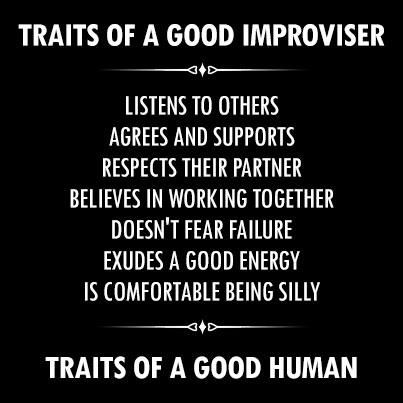
Improve Through Improv

Improv picture

Today I am preparing to take my son to the Destination Imagination global competition in Knoxville, TN. Destination Imagination (DI), is an educational nonprofit dedicated to teaching students the creative process and empowering them with the skills needed to succeed in an ever-changing world. Quite the mission statement! DI poses different challenges to kids and asks them to solve them using either technical, engineering, fine arts, improvisation (improv), or service learning. I am lucky enough to coach a talented group of teenage boys on their improv challenge. I have learned some of my best leadership and innovation lessons through DI – lessons that apply directly to business. Forty-three percent of business executives that participated in a 2014 PwC study agreed that innovation is a “competitive necessity” for their organization. PwC also found that 93 percent of business executives believe that organic growth through innovation will drive the largest proportion of their revenue growth. Yet how many of us are spending 43% of our time innovating? Are 93% of your leaders empowering your teams to innovate new solutions? We can improve our innovation by taking a few tips from the practice of improvisation, including using “yes and”, go all in, and trust the team.

“Yes and…” This is also called the ‘Don’t deny’ rule. It means that you should always say yes. If the person you’re working with has an idea, build upon what they have created instead of responding with no, but, or we can’t.  In the world of improv that means that if your scene partner starts the scene by saying you are on a trip to Mars, then you must embrace that you are heading to Mars. Denying their statement discredits your partner and creates tension in your scene. Your next line might be, “Yes and I am so glad I brought my dog Fido with us for this adventure!” So let’s replace this with a workplace scenario. Let’s say you were planning a meeting today to discuss the team budget, and one of your employees says that they need another contractor to meet a critical project deadline. A “yes and” response would be, “Ok, let’s evaluate how to add another resource and how to stay on budget.” This acknowledges their reality, respects their idea, and opens a new dialogue. “Yes and” is an incredibly simple but powerful practice that welcomes new ideas and collective problem solving.

Go all in. Improv is about being in the moment. You can’t worry about looking silly, or thinking about the next funny line you want to work into the plot. If Fido is going to Mars with us, then I may need to become a dog. Or a martian. Or both. The only way I will know is to get out of my head and to jump all the way into whatever is unfolding in the moment. Imagine sitting in a board room and hearing a valuable insight from a colleague while you are in the midst of a presentation. What would happen if you put the clicker down and gave him/her the floor? You might not complete your PowerPoint, but you might generate a new collaboration opportunity because you broke free of structured roles and responded to a new idea.

Trust the team. In my son’s improv challenge they have to plan and perform 3 three minute skits in three different genres, with three different main characters, using a prompt they get three seconds before they begin. I will admit sometimes I panic that they will forget an element or stress about their time management. Then I watch them and I am humbled again at their ability to focus on what is happening, not what might happen. How powerful! Imagine turning your team loose on a big project and saying these are the three big outcomes we have to get to. How you do it is up to you, and I trust that you will make the right decisions along the way.   What if instead asking for status reports we generated innovation insights from our team, asking them what they are learning and what else is possible?

I realize life – and business- is not a stage. We do need some structure and process to make innovation sustainable. Companies can’t just innovate ideas, they also need innovation strategies to align, prioritize, and focus efforts around them. However on the continuum of structured and improvisational, most organizations- and leadership practices- focus on tried and true approaches as opposed to fail fast testing.  My challenge to you is to ask yourself where can I try a “yes and”, go all in, or trust the team?  In the words of football coach Pete Carroll,  “Improvisation (is the) natural expression of the best we can possibly be. It comes out because there is no boundary to hold us back. That’s the mentality that I’m trying to create, recreate and hold on to forever.”

The Tears and Fears of Change

FearOfChange

One of my favorite 80’s songs is “Change” by Tears for Fears. In the song Curt and Roland lament, “I did not have the time. I did not have the nerve. To ask you how you feel. Is this what you deserve?” When I hear this stanza, it makes me think of how well intended change initiatives often unfold. John Kotter’s research on organizational change found that 70 percent of transformational change initiatives fail (Harvard Business Review, 1995). The Towers Watson 2013 Change and Communication ROI Survey shows that only 25% of change initiatives achieve long term success.  Most of us can recall a recent change initiative at work that fell short of its initial promise. So why do we keep our needle in the same groove when we know it isn’t working? There are a number of effective change models and frameworks that outline the critical steps in a change process.  Where we often forget to focus is on the change preparation. What do we need to do before kicking off an organizational change?

Take the time and have the nerve. In Jim Collin’s book Good to Great he talks about how great companies get the right people in the right seats on the bus.  I couldn’t agree more. But before your change bus embarks on a new initiative ask the passengers if they have the time to take on the project. The “right people” are often the same people we ask to do everything.  How can this specific project take precedence over their other objectives? Why should it be their main focus? What will impact their pay and incentives — this initiative or their day job? If we don’t ask and evaluate these questions we can quickly steer the change off course before it leaves the parking lot. A real bus makes stops and lets people on and off. Before launching a change how can we give people permission to get on and off the project at different stages?  It take guts to say, I would love to help kick off the project but my lack of attention to detail and work demands will make me less effective in the next phase of the project. But imagine the impact we could have if we gave individuals that license.  Lack of time, passion, and commitment are common road bumps- or roadblocks- on the change path. Before hitting the gas, evaluate your team and their commitments carefully.

Ask how people feel and what results we deserve. Communication is a staple step in all change models. Understanding why change is needed is a critical element in changing behavior.  Unfortunately too many change communication plans seem pre-recorded, telling employees why a change is needed once the destination has been determined. What if instead we invite employees into our recording studio to help us lay down the track?  Asking for employee’s voices before decisions are finalized is powerful and insightful. It helps us hear both what they know and how they feel.  Before we invest time and resources in a change, it is critical to invest in listening to our teams.  What do they love about the current state? What do they hate? What do they wish for? What are they worried about? Understanding the emotional current state can provide invaluable insights on how to design the future state. While you’re having these discussions, take a deep breath and ask, “So what results do we deserve?” Be honest with yourself and encourage your employees to be honest with you. Have you underfunded or under resourced the project? If so, share the project timeline and ask what risks they see and what recommendations they have. Have you responded to the latest employee engagement feedback? If not, revisit the feedback with your employees and understand what they are looking for from you.  Leaders need follower-ship to make change stick. Have you examined other factors- internal or external- that are competing for airspace with this change?  Engage your employees in brainstorming how, given this reality, the change can be effective.

Change is hard work- and even harder if we don’t take the time to prepare effectively for it. So take some advice from Tears for Fears and take the time, have the nerve, and understand how people feel so you can move the needle and make change stick in your organization.