
Champion Experienced Talent

Wimbeldon

This year’s Wimbledon was notable – Roger Federer won his eighth singles championship and, at age 36, is the oldest man to do so. Venus Williams was the oldest woman since Martina Navratilova to reach a Wimbledon singles final at age 37. In sports and work we often focus on our up and comers – which to be sure are a critical part of our talent pipeline. But what is our strategy to keep our most experienced talent engaged and winning? These employees hold our tribal knowledge and legacy resources, but instead of drawing them into our inner circle, we often assume they are on their way out to pasture. To get the most out of our most experienced employees we should take some lessons from our Wimbledon stars – go big and go home, draw on and redraw experience, and grow your grit.

Go big and go home. Federer is featured in an ESPN article, titled Once More with Feeling. The critics have been questioning his ability to stay competitive and overcome his injuries, suggesting it may be time for him to retire. It is true that he has been nagged by injuries – including tearing his meniscus in 2016 while bathing his children in Melbourne, which required surgery. Federer could have seen this as a sign it was time to hang it up. Instead, he changed his approach to training. He focuses on how he can save energy, picking and choosing key tournaments. He also embraces his time off, realizing that time off the court is a key part of allowing him to succeed. “I can just play the tournaments I want to play and enjoy the process,” he says. “If I do show up and play, I love it. When I’m in training, I enjoy being in training. When I’m not in training, if I’m on vacation, I can enjoy that. I’m not in a rush. So I can take a step back and just actually enjoy.” As leaders it is important for us to encourage and celebrate this kind of balance for our experienced talent. Imagine that instead of lamenting “Mary”s” inability to travel as much anymore, we sent her to our most critical engagements, and had her spend more time in the office training and mentoring the team? What if we partnered with “Dave” on a phased retirement plan, allowing him to work for us part time so we can preserve his knowledge? Expecting results and respecting personal time are not ideas in conflict – in fact they are both essential ingredients in retaining our most experienced employees.

Draw on and redraw experience. Federer’s reputation is that it all comes easy. He is seen as the standard of perfect tennis by many, and it is this perfection that draws in many of his fans. But even Roger Federer experiences doubts and negative self talk. In the 2017 Australian Open he was down and getting down on himself. But then he said he reset his mindset, “not thinking too much about the what-ifs … the pressure, the moment. I know it’s huge, we all know it’s huge, but just try to shake it off. Don’t freeze up. Fight, but don’t try too hard and want it too much.” He went on to win the game, and in his opinion, have one of the best matches of his life. In moments of great stress, our most experienced talent has the frame of reference to draw on what has worked before and the confidence to redraw the final chapter. As leaders we need to learn how to tap into this combination to fuel the team. Is your Lean project team feeling stuck? Invite your most senior salesperson to share her customer knowledge and help shape the final design. Struggling with your new marketing campaign? Ask some of your tenured technical experts what feels authentic to your brand, and where you are coming off wanting it too much. Encouraging our experts to share their experience and thoughts with us can drive both engagement and innovation.

Grow your grit. Venus Williams is one of the greatest tennis players of all time. Williams holds fourteen Grand Slam doubles titles and two mixed doubles titles, five Wimbledon singles titles, and at this year’s Wimbledon, extended her record as the all-time leader, male or female, in Grand Slams played, with at total of 75. She has won four Olympic gold medals, and has 49 singles titles, second among active players on the WTA Tour. She is second to sister Serena Williams, who has been her most challenging rival. Williams has demonstrated incredible grit on the court – including several comebacks after injuries and being diagnosed with Sjögrens Syndrome. She has also shown grit off the court, facing criticism for her physical looks and play and for her outspoken style. She fought for – and won – equal pay for female athletes at Wimbledon, and she was cited as  “the single factor” that “changed the minds of the boys” and a leader whose “willingness to take a public stand separates her not only from most of her female peers, but also from our most celebrated male athletes.” Honoring the grit of our experienced talent is key to showing our employees what we really value. Consider creating a Grit Award in your organization, highlighting the finance leader who helped you successfully navigate multiple mergers and have him share his lessons learned.  Expand – or start – Lean In Circles in your organization and have experienced women share their war scars and wisdom with other women – and men – in your company. 

“Champions keep playing until they get it right.”- Billie Jean King.

On the court and in your building are champions who have been working hard to perfect their game over the years. They have a tremendous amount of knowledge, connections, and resources that can help you serve up an ace if you tap into them to help you go big and go home, draw on and redraw experience, and grow your grit.



Leadership Lessons from Princess Bride

Pbride2

“Good night, Westley. Good work. Sleep well. I’ll most likely kill you in the morning.”- Dread Pirate Roberts.

It is the 30th anniversary of the cinematic classic, The Princess Bride, this year.  This fairy tale adventure centers around Princess Buttercup and the hero, Westley, who is on a quest to find and save her. It is also a story that unfolds as the grandfather reads the Princess Bride book to his grandson, while the boy recovers from his illness. There are so many great quotes and moments in this movie. There are also a lot of good, timeless leadership lessons embedded in this tale, including some gems from Prince Humperdink, Vizzini, Inigo Montoya, Westley, and the Grandfather.

Prince Humperdinck:  Prince Humperdinck has a leadership title but does not focus on or rally supporters. He is totally self-absorbed and pursues Princess Buttercup not for love, but for power. There is a scene where Westley was captured and Humperdinck is asked if he wants to come to the dungeon. The Prince responds, “You know how much I love watching you work, but I’ve got my country’s 500th anniversary to plan, my wedding to arrange, my wife to murder and Guilder to frame for it; I’m swamped.” Ever worked for this guy? The outtake: Titles don’t make leaders, character does.

Vizzini: Vizzini is the movie’s villian, hired to kidnap and kill Princess Buttercup. He plans elaborate schemes to trick others and to try to get his way. He is convinced that he is the smartest person in the room and that no one else can be trusted, so talks down to everyone he encounters. It is “inconceivable” to him that anyone else could outwit him. In an exchange with the Man in Black he states, “I can’t compete with you physically, and you’re no match for my brains…Let me put it this way. Have you ever heard of Plato, Aristotle, Socrates? (They are) morons.” His ego prevents him from connecting to others and ultimately, in an elaborate game of slight of hand costs him his life. The outtake: Leaders need brains, and they also need humility.

Inigo Montoya: Inigo Montoya joins our hero on his quest, not to save Buttercup, but to avenge his father. His life’s purpose has been to find and kill the man who killed his father. He has unquestionable dedication and drive- but it is this same single-mindedness that narrows his perspective of the world. He laments to the Man in Black that “It’s been twenty years now and I’m starting to lose confidence. I just work for Vizzini to pay the bills. There’s not a lot of money in revenge.” After almost wrongly killing the Man in Black, he does finally get to put his iconic line “Hello. My name is Inigo Montoya. You killed my father. Prepare to die,” into action. The outtake: Leaders are motivated by passion and the big picture.

Westley: Westley is our hero. He is a farmhand in love with Princess Buttercup who sets out to earn the money needed to ask for her hand in marriage. Of course like all good movies it is not all smooth sailing for our hero, Westley, who has to use his wits and his sword to fight pirates, to outwit Vizzini, and to find his way back to Buttercup. His simple background and demeanor belie his commitment and passion. This may be best represented by his line “As you wish.” At first Princess Buttercup thinks it is because of her status that he defers to her but as their relationship progresses she comes to see it is because he loves her and wants what is best for her. The outtake: Leaders are found at all levels.

Grandfather:  The Grandfather brings the book the Princess Bride to read to his sick grandson who initially wants nothing to do with it. Once the Grandfather promises to skip all “the kissing parts” the grandson relents, then is quickly enraptured by the story.  As the grandfather is reading the story to the grandson about the Buttercup’s upcoming marriage, the grandson interrupts, “See, didn’t I tell you she’d never marry that rotten Humperdinck?” to which the Grandfather smirks and replies, “Yes, you’re very smart. Shut up.” The grandfather successfully draws his grandson into the story by inviting him to partake in the adventure and letting his Grandson form his own ideas and draw his own conclusions. The outtake: The best leaders draw the outline and let you color in the details.

The movie Princess Bride has humor, action, and adventure. It also has a lot of good leadership lessons embedded throughout the film. Think about the characters in your office and the parts that they play.  Most importantly, remember that “wuv, tru wuv, will fowow you foweva… So tweasure your wuv. ”


Retune Your Approach to Communications

album

I recently read Seth Godin’s blog Greatest Hits Are Exhausting, and it really hit home. We are enamored with what is comfortable and popular. But, as Seth so eloquently says, “Popular isn’t the same as important. Popular isn’t the same as profound. Popular isn’t even the same as useful.” Think about your favorite singer/band growing up. I am guessing after you bought the album you came to like most of the songs, not just those you heard on the radio. In college, I collected B sides from my favorite artists so I could expand my understanding of their music. Yet today we have fallen prey to the Itunes algorithm mentality both in music and at work. We pump out greatest hits stories to our candidates, employees, and customers instead of embracing our full, rich library of experiences. We focus on what we think our audience wants to hear at the expense of trusting them with our full story. And it is not working. According to the 2017 Edelman Trust Index , only 52% of respondents believe that businesses are trustworthy and only 37% believe that CEOs are trustworthy. The CEO rating is an all time low, with 23 of the 28 countries surveyed rating CEO trust below 50%. How can we react to numbers this dismal? Our best play is to tune our communications to be authentic, to share everything you can, and to read between the lines.

Be Authentic: Trust is earned, and broken, by how we engage with our teams. In Stephen M. Covey’s book, The Speed of Trust, he talks about the “trust tax” most companies incur because employees don’t think their bosses communicate honestly. The tax is the expense of reduced speed and increased costs that result when people are distrustful. Communicating authentically is the number one action leaders can take to improve trust within their organizations. That means eliminating phrases like “achieving operational excellence” when the truth is “we need to reduce staff because we are eliminating this product.” The same is true with candidates.  Imagine if you skipped over the first date politeness with candidates and let them know that “we are a global company with lots of opportunities and resources. However, we also have a lot of bureaucracy and politics, and you’ll need to be good at navigating that here to be successful.” Employees and candidates have already formed their opinions about whatever you are selling. Focusing on facts and transparency will go a long way in gaining their buy in and their respect.

Share everything you can. Layoffs and acquisitions are part of business. Employees know to expect them.  However they also personally know Mary, who was just laid off after 30 years. They know that in the last acquisition jobs were lost and are worried about their security. Engage employees in dialogue- don’t subject them to a monologue. Share your personal thoughts and feelings about the announcement. Be honest about what is keeping you up at night- and ask for your team’s ideas on how to address your your concerns. The same notion holds true with customers. If industry news breaks about your company, don’t wait for the client to call you. Call them first and confidently share what you can about the news. If you are thinking of restructuring your sales team, share your thoughts and ask them for theirs. This is more than just a communication tactic. It’s how you build a reputation internally and externally.

Read between the lines. Great leaders have the uncanny ability to focus on the unspoken message in the room. Nodding heads don’t necessarily mean agreement or support. These is much to hear in the unsaid words behind an employee’s question. Leaders who focus on their talking points miss the message coming back at them. Invite the elephant into the room and host the conversation that needs to happen. Use questions, humor, stories, analogies, and data to engage the team. You may leave having had a totally different conversation than you planned, but likely it was the one that needed to occur.

Tina Turner once said “Making a greatest hits album is easy because you don’t actually have to do anything.” In today’s fast-paced, results-oriented world, there is comfort in repeating and replaying popular messages. But that approach tunes out new ideas and limits our possibilities. Retune your communications approach to drive engagement and business results. Engaging employees, candidates, and customers by being authentic, sharing everything we can, and reading between the lines will be music to their ears.


You Can’t Spell Change Without a D

Desire.jpg

“If you speak to a man in a language he understands, that goes to his head. If you talk to him in his own language, that goes to his heart.” – Nelson Mandela.

Change is inevitable. Change moves us forward. Yet 70% of change initiatives fail. Many companies are taking on large, complex business transformations and are investing in change management consultants and change training to improve their odds of success. These investments are valuable – according to Prosci, projects with excellent change management have six times the rate of success than those that don’t. But the consultants leave, change training often isn’t sustained, and leaders jump into the next initiative without looking back. Prosci’s ADKAR model spells out the critical elements to making change successful: Awareness, Desire, Knowledge, Ability, and Reinforcement. Most leaders understand the importance of awareness. Explaining why the change is happening and necessary is a critical step in the change process. We often invest a lot in knowledge via training and, if it’s done right, that knowledge can spur and develop people’s ability to make the change. What we often overlook is the importance of desire. Desire is the most challenging element of change because it can’t be solved with a process or a Powerpoint. Many managers believe we pay people to do what they are told and are uncomfortable leaning into the personal side of change. But organizational change is dependent on individual change. Addressing desire means giving employees a voice, focusing on the WIIFM, and acknowledging individual’s choices.

Giving employees a voice. Once we decide to embark on a change initiative, we should quickly solicit employee input on the change. Engaging those closest to the work early in the change is critical. A recent Aon white paper showed that when companies undergo a large change, connection and control are two of the biggest drivers of engagement. Employees want to have a personal connection to leaders. The Best Practices in Change Management 2016 report states that the number one contributor to a change initiative’s success is how visible and actively engaged senior leaders are. Leaders need to engage in two way dialogue to listen to and validate employee concerns and to provide factual information about what is changing. Giving employees a voice is an important part of giving them control. In most changes employees feel the change is happening to them rather than feeling they are involved in the change process. Inviting employees to provide ideas, react to different scenarios, and have a say in the outcomes allows people to participate in the change rather than simply being recipients of change.

Focusing on the WIIFM: This is the step where many organizations stumble. WIIFM is not what’s in it for the executives and the shareholders. It’s What’s It In For Me. The truth sometimes is that there’s not much in it for me. In which case we need to communicate the WIRM: What Is Required of Me. Employees are adults that we trust with our brand, our customers, and our IP. We need to give them that same level of trust with information about change. Executives are best positioned to explain why we are changing and the new organizational direction. Managers are best positioned to talk about the WIIFM and WIRM. Employees are more likely to trust their manager than an executive and are more likely to be candid with their direct leader. Managers can then raise feedback and concerns from their team back up to leaders. This means we need to ensure managers can explain the change confidently and accurately in their own words. Corporate speak about “leverage” and “bifurcated processes” won’t resonate. People want to know what they will gain, what they will lose, and what they need to do differently as a result of the change. The less room we leave for speculation, the more energy people can put into moving forward.

Acknowledging individual’s choices. Try as we might, we can’t will our way through change and sustain the results. Listening to and addressing employees’ concerns, modifying plans based on their feedback, and being honest about what’s changing are the bricks we lay to invite them down the path of the change. Acknowledging that people are going to have to make tough choices such as giving up their expertise in a certain system, moving to a new team, and/or taking on new responsibilities is important. It is also important to highlight the benefits of the change, including new incentives, appealing to employees’ values, avoiding risk, and/or improving the current state. Helping employees navigate the micro and macro choices along the change is essential to maintain the change’s momentum. Most people will come along once they understand the “why” and if they feel they had some voice in the “what, how, or when.” We also need to make it ok for people to opt out. As Jim Collins says in the book Good to Great, it is important to get the right people on the bus, the wrong people off the bus, and the right people in the right seats. It’s ok if someone can’t get on board with the change. However that also means choosing to get off the bus and finding a new destination.

80-100% of change initiatives are dependent on people working in a new way. How quickly the change was adopted, how many employees are using the new solution, and how well employees are performing in the new model are tangible ROI change measures. If we want to win our team’s hearts and minds, we must listen to their thoughts and speak in their language. Desire may sound squishy but it is a key part of a change plan. Without desire, our investment in knowledge and ability won’t reap rewards. Giving employees a voice, focusing on the WIIFM, and acknowledging individual’s choices are key elements in building desire and in making change sustainable.


Your Best Work Can Be Done From Anywhere

Work from home

My dad was a 20+ year IBMer. He was an employee of the blue suit era – where people whispered if you wore striped ties. Former IBM CEO Lou Gerstner worked hard to teach the IBM elephant how to dance, transforming the company from a computer manufacturer to a solutions provider. This transformation was not easy nor was it without casualties, including IBM’s culture of “employment for life” and pensions – painful changes for my dad’s generation. Gerstner recognized that IBM had to change it’s fundamental economic model and re-engineer how they did business or go out of business. IBM successfully branded and built their solutions business, and is pioneering exciting AI work with its Watson system. On IBM’s homepage they promote the power of Watson:

With Watson, you have the AI platform for business. Uncover insights, engage in new ways, make decisions with more confidence and do your best work with Watson, today.

IBM choose not to put its latest business disruption on their website: the decision to end remote working. On May 19th IBM announced, “In many fields, such as software development and digital marketing, the nature of work is changing, which requires new ways of working.” The problem IBM has identified is the need to drive greater innovation, improve communicate and make faster decisions. Their solution is to require all of their almost 400,000 employees to work on location. I strongly disagree with this decision, and think it is counter intelligent. Instead I would advise IBM and all companies to follow Watson’s recommendations: uncover innovation insights, engage in new ways of communications, and make decisions with confidence so that employees can do their best work wherever they work.

Uncover innovation insights. IDEO is an award winning product innovation company. Their success comes using empathy to uncover insights. By observing user behavior and putting yourself in the end-user’s shoes, you collect invaluable insights. Remote teams can help companies know and go to your customer across a large footprint. Leverage vs. eliminate remote teams to foster better customer collaboration. Innovation comes from shifting from “we can’t” to “we can if…”. It thrives when we welcome diverse perspectives and collaborate under constraint. Remote teams live in this petri dish and can help companies create best practices for innovation.

Engage in new ways of communication. The article News Flash From IBM. There IS a Downside to a Remote Workforce points out that it is more challenging to communicate on remote teams. It is hard to have impromptu conversations or to drop in on peers when you work remotely. But does harder mean impossible?  Global employees communicate across a complex network of remote customers, suppliers, and contractors everyday. Instead of opting out of this challenge, companies can and should apply the same principles for working with global teams and use them with remote workers. Create clear strategies. Connect the team’s work to those strategies. Check in frequently and personally with individual team members. Create space for unstructured, impromptu discussions in your calls and meetings. Invest in building good leadership and communication skills vs. dismantling remote work structures.

Make decisions with more confidence. Watson’s power is its ability to analyze multiple sources of information and derive insights and recommendations. On its website, IBM states, “Watson can understand all forms of data, interact naturally with people, and learn and reason, at scale.” The good news is teams, remote or co-located, don’t need a supercomputer to improve their decision making skills. We can understand data by staying objective and focusing on facts. We can interact with others to understand connections, implications, and lessons learned. We can learn and reason by using industry trends and experts in our field, then applying our knowledge of our company and customer to form a hypothesis. Good leaders know success doesn’t come from obsessing about the right decision but rather from making timely, confident decisions.

Watson is an incredible breakthrough for IBM and has thousands of exciting applications, including cancer research, aviation, and energy.  The Toronto Raptors are partnering with Watson to analyze the play of their roster, determine what skills are missing, and recommend the best players that suit its needs. Watson will include both basketball skills and team camaraderie skills in its analysis. I’d encourage IBM and all companies to apply this same logic to its workforce. Given it’s current employee roster and skill set, is it more advantageous to focus on clear goals, expectations, and engagement for remote teams or to let them quit and work for a competitor? IBM- and all employers- have the ability to uncover innovation insights, engage in new ways of communications, and make decisions with confidence so that employees can do their best work. Let’s make the intelligent decision.


Walk A Mile in My Gemba

Gemba-Kaizen-Quotes-Morpheus

Lean principles are no longer a new idea in the workplace. As many workplaces try to “do more with less”, identifying and eliminating waste not only makes sense, it is essential. A key element of the lean methodology is to “walk to the gemba.” The original Japanese term comes from gembutsu, which means “real thing.” It also sometimes refers to the “real place.” This concept stresses making a personal observation of work at the place where the work is happening.  Walking the gemba is a learning activity. We can learn how to do address delivery and quality challenges, how to deal with internal quality problems, how to sustain inventory, and how to make a better use of capital. We can also learn from our teams by asking the people closest to the work what they see as waste and what recommendations they have for improvement. I recently read the article Your Gemba Isn’t the Only Gemba to Walk by Aaron Hunt in the Lean Post. He highlights the value in seeing how others (your customers, your competitors) are working on challenges, and encourages us to walk their gembas for ideas. This got me thinking – what if we applied that to our own organizations?  The article The Future of HR: Run like Tech. Talk like Ops. Think Like Sales. Lead the Change by Jeff Palen offers some great recommendations on ensuring HR runs like a business. I think we can take this one step further by going to the gemba together to help each of these functions learn from each other. If we do, we can connect technology and talent, measure what matters, and be more customer-centric, and by doing so we will drive business value.

Connect technology and talent. Gone are the days of massive annual IT updates, where people were given big binders of instructions and had their systems down for hours while the new release was launched. Instead, technology has moved to micro releases sending regular, small updates in real time. HR could ask IT how to redesign the talent review as a micro release process instead of today’s annual, big binder process. By observing the process steps and the waste removed, HR may gain some insights on how to redesign their own talent process. In exchange, IT could ask HR how to engage stakeholders before a release is launched. An incremental release of a Workday program may launch but won’t stick unless managers understand why the change was made, believe this change is for the greater good, and understand how to execute the change.

Measure what matters. Operations teams are often experts in ROI metrics. Common customer experience metrics used by operations teams include on-time delivery, cycle time, and time to make changeovers. Walking through an operations gemba you may see the line stop and manufacturing employees giving feedback on an inefficiency that slows down delivery and/or cycle time. HR could ask Operations if performance reviews are efficient and if they measure what matters. Are managers delivering feedback in a timely manner? Is the cycle between feedback discussions optimal? Have managers changed over to the feedback approach you launched? In exchange, Operations could ask HR what internal customers are measuring. Is Quality measuring supply chain stability but Operations is switching to low cost suppliers? What are HR incentive plans designed to drive? Is that in synch with what operations is measuring? Making these connections is key to making ROI metrics real.

Be customer-centric. Sales people know that knowing your products is important but knowing your customer is essential. Key elements of the sales process are prospecting, conducting a needs assessment, and presenting benefits to the customer. HR could ask Sales how to better engage their customers.  For example, you may have identified major market segments (employees, managers, executives) but have you fully profiled each of these in order to adjust marketing tactics appropriately? Is your engagement strategy designed to solve your prospect’s problem? The only way to do that is by asking lots of questions. Asking good questions will not only help you determine potential solutions, but also builds confidence, trust, and may help prospects consider ideas they may never have thought of.  In exchange, Sales can ask HR how to better engage their employees. Gemba walks are a great way to do this, and anywhere a sales employee works is a place for a gemba walk. That could be in a home office, a car, or an onsite customer meeting. A gemba meetings looks at flow: what is the process, who are the people, and where is the friction. By asking the employee questions and offering him/her coaching, the sales leader can drive both results and engagement.

Most functions believe they know what their peer functions do. But as the quote says, there is a difference between knowing the path and walking the path. By walking the gemba together we can get to the “real thing” we need to address to improve our performance. We can also learn from those closest to the work how we are generating waste and what recommendations they have for improvement. How could you walk the gemba with your peers at work?


Escape from Mentoring Women

Escape Room picture

The word mentor was first introduced as a character in Homer’s Odyssey. Odysseus, king of Ithaca, fights in the Trojan War. Odysseus turns over the care of his household and son to Mentor, because Mentor is trusted to act in Odysseus’s image. In today’s rendition of mentoring, we connect a senior, more experienced,  leader with a junior, up and coming, employee in the organization. Mentors are expected to share their experience and insights with their mentees to illuminate their work odyssey. Many mentoring programs focus on giving women a hand up in the organization. There is data to support this idea- according to a Forbes article, employees who received mentoring were promoted 5 times more often than those who did not. So what’s wrong with mentoring women? Mentoring, in its traditional format, reinforces the idea that men have the answers and experience needed to succeed and that women will succeed if they can be trusted do exactly as their male mentor would do. Instead, I’d like to propose a new model for mentoring that looks more like an Escape Room game- one focused on outcomes, challenging assumptions, and solving problems.

Focusing on outcomes. Mentors can be good sounding boards. Many mentoring meetings are a safe space to blow off a little steam, and a place to get some advice on what you could do differently next time. However, looking backwards rarely moves us forward. What if instead of just situational coaching, mentors and mentees focused on outcomes and used mentoring sessions to talk about obstacles, relationships, and skills needed to get to that outcome? When you enter an escape room you begin an odyssey — there is a mission, there will be challenges, and there is a timeline in which the outcome must be reached. Some of my best mentoring meetings helped me shift my focus from my frustration with a particular incident to identifying my goal around a bigger outcome. My mentors and I identified landmines, fiefdoms, and holy grails and these could impact my desired outcome. They respected that this was my quest and didn’t offer answers but instead prompted my thinking.

Challenging Assumptions. You see a clock in the escape room and it says it’s 12:00. Is that a fact, a falsehood, or a clue? You will need to take it down, turn it over, and evaluate it to find out. Successful mentors spend a lot of time challenging assumptions. Just because I took this career path, does that mean it is the only way? Or the right way for you? I have been successful because I am a confident extrovert. Does that mean I believe collaborative introverts don’t make good leaders? We have never had flexible scheduling here, so you will need to accept that. Or maybe I could help you bring your case for why that change is needed to the right people. Mentees also need to challenge their assumptions. I have to take that job to get ahead even though I hate it. I can’t take that assignment – I have two young kids and can’t take on anything else. I have to take that assignment even though I have two young kids and I am ready to quit. Good mentoring discussions take down the clock and look at it from all angles. What am I missing? What else could be? What if would happen if… Sparking that kind of critical thinking is a good for building relationships and for building business possibilities.

Solving problems. My biggest frustration with mentoring programs is when we build a plank over shark filled waters, then pat ourselves on the back that we have created a path to success. The sharks are still there. What if instead of teaching people how to precariously balance their way through a broken system, we instead focused on the system? HR analytics can be a good place to start- in addition to perceptions we hear or feel, what does the data tell us is holding women back? What roles have the fastest promotion rates for women? The slowest? Is this different for men? What functions have the most women in individual contributor roles and the fewest in leadership? Do high potential women advance at the same rate as similarly situated male counterparts? These questions allow us to look at root causes and discuss potential solutions. In an escape room the whole team needs to get past the challenge to succeed. We all need to put our pieces of the code together in order to open the door. Helping one individual can be a start but can’t be the end to a successful quest.

Homer said, “There is no greater fame for a man than that which he wins with his footwork or the skill of his hands.” Mentees can and want to succeed on their own path, using their own ideas and approaches. Mentors can play an important role in organizations by helping mentees focus on outcomes, challenge assumptions, and solve problems. If we all go all in, we can escape the fallacy of traditional mentoring and succeed in advancing women and advancing our business goals.

Improve Through Improv

Improv picture

Today I am preparing to take my son to the Destination Imagination global competition in Knoxville, TN. Destination Imagination (DI), is an educational nonprofit dedicated to teaching students the creative process and empowering them with the skills needed to succeed in an ever-changing world. Quite the mission statement! DI poses different challenges to kids and asks them to solve them using either technical, engineering, fine arts, improvisation (improv), or service learning. I am lucky enough to coach a talented group of teenage boys on their improv challenge. I have learned some of my best leadership and innovation lessons through DI – lessons that apply directly to business. Forty-three percent of business executives that participated in a 2014 PwC study agreed that innovation is a “competitive necessity” for their organization. PwC also found that 93 percent of business executives believe that organic growth through innovation will drive the largest proportion of their revenue growth. Yet how many of us are spending 43% of our time innovating? Are 93% of your leaders empowering your teams to innovate new solutions? We can improve our innovation by taking a few tips from the practice of improvisation, including using “yes and”, go all in, and trust the team.

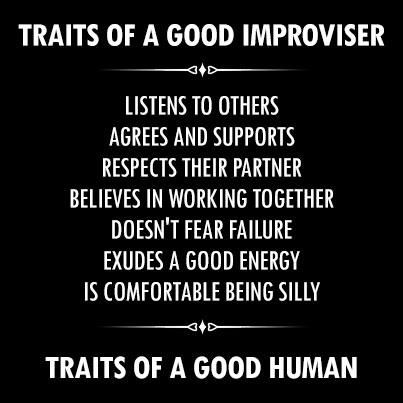
“Yes and…” This is also called the ‘Don’t deny’ rule. It means that you should always say yes. If the person you’re working with has an idea, build upon what they have created instead of responding with no, but, or we can’t.  In the world of improv that means that if your scene partner starts the scene by saying you are on a trip to Mars, then you must embrace that you are heading to Mars. Denying their statement discredits your partner and creates tension in your scene. Your next line might be, “Yes and I am so glad I brought my dog Fido with us for this adventure!” So let’s replace this with a workplace scenario. Let’s say you were planning a meeting today to discuss the team budget, and one of your employees says that they need another contractor to meet a critical project deadline. A “yes and” response would be, “Ok, let’s evaluate how to add another resource and how to stay on budget.” This acknowledges their reality, respects their idea, and opens a new dialogue. “Yes and” is an incredibly simple but powerful practice that welcomes new ideas and collective problem solving.

Go all in. Improv is about being in the moment. You can’t worry about looking silly, or thinking about the next funny line you want to work into the plot. If Fido is going to Mars with us, then I may need to become a dog. Or a martian. Or both. The only way I will know is to get out of my head and to jump all the way into whatever is unfolding in the moment. Imagine sitting in a board room and hearing a valuable insight from a colleague while you are in the midst of a presentation. What would happen if you put the clicker down and gave him/her the floor? You might not complete your PowerPoint, but you might generate a new collaboration opportunity because you broke free of structured roles and responded to a new idea.

Trust the team. In my son’s improv challenge they have to plan and perform 3 three minute skits in three different genres, with three different main characters, using a prompt they get three seconds before they begin. I will admit sometimes I panic that they will forget an element or stress about their time management. Then I watch them and I am humbled again at their ability to focus on what is happening, not what might happen. How powerful! Imagine turning your team loose on a big project and saying these are the three big outcomes we have to get to. How you do it is up to you, and I trust that you will make the right decisions along the way.   What if instead asking for status reports we generated innovation insights from our team, asking them what they are learning and what else is possible?

I realize life – and business- is not a stage. We do need some structure and process to make innovation sustainable. Companies can’t just innovate ideas, they also need innovation strategies to align, prioritize, and focus efforts around them. However on the continuum of structured and improvisational, most organizations- and leadership practices- focus on tried and true approaches as opposed to fail fast testing.  My challenge to you is to ask yourself where can I try a “yes and”, go all in, or trust the team?  In the words of football coach Pete Carroll,  “Improvisation (is the) natural expression of the best we can possibly be. It comes out because there is no boundary to hold us back. That’s the mentality that I’m trying to create, recreate and hold on to forever.”

Replace Your Recruiters With Marketers

Marketing

Let me start by saying I have a lot of respect for recruiters. I have been a recruiter. I have led teams of recruiters. I have many friends who are recruiters. Recruiting is a critical part of building an organization’s talent pipeline… and this is why I believe we should replace a recruiting mindset with a marketing mindset. A recruiting mindset focuses on process and procedures. A marketing mindset focuses on the customer and creating connection. Marketing at it’s core is the process of identifying, anticipating, and satisfying the customer’s wants and needs better than the competition. In today’s social media world, a bad hiring process could be your Pepsi commercial. Your candidate is often also your customer -or was. According to a recent survey of over 1,000 recent job candidates, 64% of job seekers say that a poor candidate experience would make them less likely to purchase goods and services from that employer. One-third of the job seekers post about their poor experience on social media. So how can you create a marketing mindset for your recruiting team? Integrate marketing fundamentals in your recruiting — identify your target audience, anticipate their wants, and satisfy their needs.

Identify your target audience. Who are you trying to reach? What do they do? What is important to them? If you are looking to find top performing salespeople to join your organization, your interview scheduling needs to be flexible (because what they do is work and travel) and brief (because what is important to them is selling not interviewing). Looking for innovation leaders to transform your R/D department? What do they experience during your interview process? Is it innovative or are you having them sit in a conference room for four hours to conduct panel interviews? Redesigning your interviewing approach through the eyes of your target audience can be a powerful differentiator.

Anticipate wants.  Your candidate is a candidate for a reason- there is something they are seeking. Find out what it is. If he has had a progressive career in human resources including merger and acquisition work, mention your open change management leadership role. If she has a strong finance background and also lists several non-profit boards on her resume, what about that opening in your philanthropy organization? Most professional job skills are transferable- figuring out how to connect experience and passion is transformative.

Satisfy needs. Satisfaction is the fulfillment of one’s wishes, expectations, or needs. One of the most fundamental expectations of candidates is that they will hear from you in a timely manner about the next stages of the process. When you check on the status of your Amazon order would you be satisfied with the reply, “I meant to follow up with the manager on that but we’ve been so busy. I have a bunch of orders I am working on.”  Timely is hours or days, not days or weeks in the candidate’s eyes. Most candidates are hoping for an advancement when taking a new job – either in salary, title, or scope. So even if you can squeeze the person into a lower salary band or if their title could map to a lower title in your organization, will that satisfy the candidate? Will they be a brand ambassador or antagonist based on their experience? 55% of job seekers who have read a negative review have decided against applying for a position at that company.  So saving pennies can cost you your brand.

According to a recent survey, 97% of employers plan to invest in employment branding in 2017 and a majority (51%) plan to increase their spending from last year. Yet very few are taking an integrated marketing approach to recruiting. The candidate experience and recruiting process are going to be connected to your organizational brand — the question is are you going to manage those impressions or learn about them on Glassdoor?  So free your recruiting team from their requisition chains and empower their marketing superpowers so they can identify, anticipate, and satisfy your candidate and customer better than your competition.