What Great Coaches Do


Landry quote

Last week I attended the Inside Out Development coaching workshop. It was a great opportunity to reground myself, an experienced coach, in the core principles of coaching and to think about how to make the idea of coaching accessible and relevant to leaders at all levels of my current organization. We all can think of great coaches in our lives (yes Janice Payton I am thinking of you!). When you ask yourself what impact they had on you, you will likely think of things like, he/she pushed me harder than I thought I could go. He/she believed in me. He/she gave me confidence and recognition. I don’t think anyone looks back and says my best coach pushed me to work every night and weekend. Believed PowerPoint was an art form. Gave me the confidence that I could be triple booked most of the time. Yet all of us, even with the best of intentions, can fall prey to the reality of workplace pressures and timelines. So what can we do to make sure we stay focused on coaching vs. tasks? After my coaching workshop I am recommitting to (1) asking vs. telling  (2) staying curious and (3) business KPIs for coaching.

Asking vs. Telling.  Think about how many questions you are asked in the course of a day. From “Mom, what’s for breakfast?” to “Can you help me with this report?” to “How should we plan our (volunteer) fundraiser this year?” And like the answer ninjas we are, we usually whip out solutions as fast as the questions are coming. It may feel efficient, but as Ken Blanchard points out in the One Minute Manager, what you are actually doing is positioning yourself as a professional “monkey collector.” All those monkeys– questions/problems others have–get lobbed your way, and you now have a new collection of monkeys to solve for- in addition to your original to do list.  So what if instead of telling, we focused on asking? In this video, Alan Fine, the founder of Inside Out Development, discusses shifting from fixing the gap we see in others, to focusing on closing the gap between our telling and asking. Fine encourages leaders to build this practice by using three simple questions: What’s working? Where are you getting stuck? What could you do differently? By starting with these questions before jumping to telling, you teach your team to reflect, empower them to solve their own problems, and free yourself from the monkeys.

Staying curious. We all have reactions to situations and people. Just saying certain names or topics, particularly in our current political times, can evoke a strong reaction and facial expression. But what if we could stay curious instead of jumping to conclusions? When you are at work, and a certain name pops up on your phone, you could roll your eyes and think,”Oh great, what could Joe want now? I’m sure he’s going to blame me that we missed our milestone.” Or, you could say, “Joe and I both know we missed that milestone. I wonder what we could do to move forward? I wonder what perspective he has on what we could have done differently?” Setting your mindset to a curious state opens you up to possibility and changes the tone of your interaction before it even begins. It takes a second to make this change, but pays off in spades.

Business KPIs for coaching. Coaching has a mixed reputation. Many HR people love it because it is good for retention, engagement, and development. Many business leaders see it is as an expense, time off the job, and squishy. If we are honest, both are true. I am lucky to be tasked with building a coaching and leadership development program from the ground up. As we develop our strategy, we will be talking about increased productivity, improved customer service scores, and higher turns as our measures of success. Of course I hope to see improved retention, engagement and development as well. But those won’t be the focus in our design or metrics.  Vince Lombardi said, “Winning is not a sometimes thing. It’s an all the time thing. You don’t win once in a while, you don’t do things right once in a while, you do them right all the time. Winning is a habit. Unfortunately, so is losing.” Substitute winning and losing with your business’s top initiative, and ask yourself if you are being relentless in getting to that end goal, and how your initiatives help your teams to build the right habits.

Coaching, like so many other elements of leadership, is talked about and trained on, but hard to put into everyday practice. In a busy world that rewards expertise and confidence, telling is a natural reaction. Making judgments helps us take shortcuts. Focusing on our function vs. our organization is efficient. But it can’t build your team’s capabilities or your organization’s long term success. Sloane Stone was ranked 83 before the US Open, and walked away a champion, the third player ranked outside the top 10 to win the U.S. Open since computer rankings started in 1975. Her coach, Kamau Murray, attributes her success to her hard work, her focus, and their honest relationship. “It’s a progression. It’s not like a one-hit wonder where she won a grand slam prior to winning anything else. If you look at her trajectory, it’s been a line of progression, it hasn’t been like a spike. When you have that kind of development, it’s more sustainable than a flash in the pan.” Let’s build sustainable wins for our business by building a coaching practice on asking vs. telling, staying curious, and one that is all about the business.


 

Connecting vs. Networking

Networking

“Networking is not about collecting contacts. It is about planting relationships.” MiSha.

The New York Times just ran an article this weekend titled Good News for Young Strivers: Networking is Overrated. The article describes networking as schmoozers getting together just to be seen and heard. The author laments that we focus on who you know instead of focusing on accomplishing great things, which, he argues, helps you develop a network. His belief is that “Networking alone leads to empty transactions, not rich relationships.” We agree on this last point – you can shake 100 hands but get to know no one. It is also true that doing good work helps open doors and can attract connections. However, people can’t connect to you if they don’t know who you are, and good work can’t be discovered if it can’t be found. I think it’s time to redefine what networking is and how to make it valuable for all parties. Networking requires three essential ingredients to be effective: connection, collaboration, and conscientiousness. No artificial sweeteners or flavors included.

Connection: Networking is not sending a stranger a LinkedIn invitation. It is not measured in business cards. Networking means connecting with someone because you are interested in their expertise. It also means showing your appreciation for their time by being prepared and respectful of their time. The book The 20 Minute Networking Meeting has some great tips on how to effectively connect during networking sessions. The key takeaways are:

  • Be prepared. Be on time– in fact be early. Stick to your scheduled time. Plan what you want to cover in advance. Google your contact in advance so you know their background and current role/projects.
  • Focus on discussions, not bios. Give a one minute overview on yourself (yes one minute). Don’t ask them to walk through their background- you should have already reviewed it. Don’t ask anything you could find out online. Do use your time to get 3 insights: For example, what do they think about X? Or, I noticed that you did Y- I’d love to hear more about how you did that. Or I’d like your advice on Z – and to share my thoughts for your feedback.
  • Ask for three more contacts. Good people know good people. Based on your discussion ask who else they know that has a similar interest or expertise they would recommend you chat with. Be sure to follow through and connect with those individuals and show your gratitude for their generosity.

As a rule people are incredibly giving of their time. It is up to you to invest that time wisely so that you make a good impression and a meaningful connection.

Collaboration: Networking is the act of both getting and giving. You should be getting information, advice, and contacts during your networking meeting. You should also be giving that individual something in return. After your meeting follow up with an article he/she might be interested in. Offer to connect him/her to people in your network. Post about the work this individual is doing and help promote their project. Networking is also about paying it forward. We have all been – or will be – new to an industry, laid off, and/or working on a stretch assignment. Creating connections with up and coming talent, people in transition, and those new to an industry helps them build confidence and contacts. It also helps you build your network so that when you need some advice or help, you have a bank of goodwill to draw upon.  Leadership is not based on power- it is the ability to empower. We all have the power to collaborate and connect, so be generous with your time.

Conscientiousness: Like any habit you want to build, creating a routine and prioritizing time for the habit is critical to making it stick. Networking feels like a chore if you view it as something that takes you away from real work and/or something competing for your time. However, if you think about networking as connecting to interesting people to collaborate with,  you create a totally different mental framework. I once had a leader who was an exceptional networker. I finally asked him how he could keep up on all the people he stayed connected to. He showed me that he had created a spreadsheet of people he wanted to stay in touch with, wanted to get to know, and had collaborated with in the past. Every Friday he set aside 15 minutes to review his list and see who he had not talked to in a while. He then sent out a personal email to three people from his list stating why he wanted to connect and offered some potential dates/times. That simple approach kept the importance of connecting in his consciousness and helped him execute on his networking goals.

The truth of the matter is that the world runs on relationships. Right Management has conducted a multi-year study on how people find jobs, and every year networking is the number one source.  Corporate America is not a meritocracy – you have to do good work and you have to have good connections to get ahead.  Connections that are authentic are built on the desire to learn and share, and connections that last are built with intention. I encourage you to lean in, not out, when it comes to networking and plant rich relationships by striving for connection, collaboration, and conscientiousness.

Champion Experienced Talent

Wimbeldon

This year’s Wimbledon was notable – Roger Federer won his eighth singles championship and, at age 36, is the oldest man to do so. Venus Williams was the oldest woman since Martina Navratilova to reach a Wimbledon singles final at age 37. In sports and work we often focus on our up and comers – which to be sure are a critical part of our talent pipeline. But what is our strategy to keep our most experienced talent engaged and winning? These employees hold our tribal knowledge and legacy resources, but instead of drawing them into our inner circle, we often assume they are on their way out to pasture. To get the most out of our most experienced employees we should take some lessons from our Wimbledon stars – go big and go home, draw on and redraw experience, and grow your grit.

Go big and go home. Federer is featured in an ESPN article, titled Once More with Feeling. The critics have been questioning his ability to stay competitive and overcome his injuries, suggesting it may be time for him to retire. It is true that he has been nagged by injuries – including tearing his meniscus in 2016 while bathing his children in Melbourne, which required surgery. Federer could have seen this as a sign it was time to hang it up. Instead, he changed his approach to training. He focuses on how he can save energy, picking and choosing key tournaments. He also embraces his time off, realizing that time off the court is a key part of allowing him to succeed. “I can just play the tournaments I want to play and enjoy the process,” he says. “If I do show up and play, I love it. When I’m in training, I enjoy being in training. When I’m not in training, if I’m on vacation, I can enjoy that. I’m not in a rush. So I can take a step back and just actually enjoy.” As leaders it is important for us to encourage and celebrate this kind of balance for our experienced talent. Imagine that instead of lamenting “Mary”s” inability to travel as much anymore, we sent her to our most critical engagements, and had her spend more time in the office training and mentoring the team? What if we partnered with “Dave” on a phased retirement plan, allowing him to work for us part time so we can preserve his knowledge? Expecting results and respecting personal time are not ideas in conflict – in fact they are both essential ingredients in retaining our most experienced employees.

Draw on and redraw experience. Federer’s reputation is that it all comes easy. He is seen as the standard of perfect tennis by many, and it is this perfection that draws in many of his fans. But even Roger Federer experiences doubts and negative self talk. In the 2017 Australian Open he was down and getting down on himself. But then he said he reset his mindset, “not thinking too much about the what-ifs … the pressure, the moment. I know it’s huge, we all know it’s huge, but just try to shake it off. Don’t freeze up. Fight, but don’t try too hard and want it too much.” He went on to win the game, and in his opinion, have one of the best matches of his life. In moments of great stress, our most experienced talent has the frame of reference to draw on what has worked before and the confidence to redraw the final chapter. As leaders we need to learn how to tap into this combination to fuel the team. Is your Lean project team feeling stuck? Invite your most senior salesperson to share her customer knowledge and help shape the final design. Struggling with your new marketing campaign? Ask some of your tenured technical experts what feels authentic to your brand, and where you are coming off wanting it too much. Encouraging our experts to share their experience and thoughts with us can drive both engagement and innovation.

Grow your grit. Venus Williams is one of the greatest tennis players of all time. Williams holds fourteen Grand Slam doubles titles and two mixed doubles titles, five Wimbledon singles titles, and at this year’s Wimbledon, extended her record as the all-time leader, male or female, in Grand Slams played, with at total of 75. She has won four Olympic gold medals, and has 49 singles titles, second among active players on the WTA Tour. She is second to sister Serena Williams, who has been her most challenging rival. Williams has demonstrated incredible grit on the court – including several comebacks after injuries and being diagnosed with Sjögrens Syndrome. She has also shown grit off the court, facing criticism for her physical looks and play and for her outspoken style. She fought for – and won – equal pay for female athletes at Wimbledon, and she was cited as  “the single factor” that “changed the minds of the boys” and a leader whose “willingness to take a public stand separates her not only from most of her female peers, but also from our most celebrated male athletes.” Honoring the grit of our experienced talent is key to showing our employees what we really value. Consider creating a Grit Award in your organization, highlighting the finance leader who helped you successfully navigate multiple mergers and have him share his lessons learned.  Expand – or start – Lean In Circles in your organization and have experienced women share their war scars and wisdom with other women – and men – in your company. 

“Champions keep playing until they get it right.”- Billie Jean King.

On the court and in your building are champions who have been working hard to perfect their game over the years. They have a tremendous amount of knowledge, connections, and resources that can help you serve up an ace if you tap into them to help you go big and go home, draw on and redraw experience, and grow your grit.


Improve Through Improv

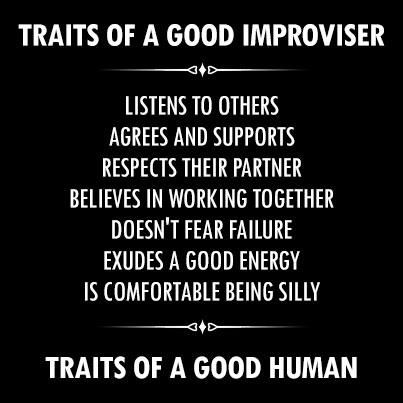
Improv picture

Today I am preparing to take my son to the Destination Imagination global competition in Knoxville, TN. Destination Imagination (DI), is an educational nonprofit dedicated to teaching students the creative process and empowering them with the skills needed to succeed in an ever-changing world. Quite the mission statement! DI poses different challenges to kids and asks them to solve them using either technical, engineering, fine arts, improvisation (improv), or service learning. I am lucky enough to coach a talented group of teenage boys on their improv challenge. I have learned some of my best leadership and innovation lessons through DI – lessons that apply directly to business. Forty-three percent of business executives that participated in a 2014 PwC study agreed that innovation is a “competitive necessity” for their organization. PwC also found that 93 percent of business executives believe that organic growth through innovation will drive the largest proportion of their revenue growth. Yet how many of us are spending 43% of our time innovating? Are 93% of your leaders empowering your teams to innovate new solutions? We can improve our innovation by taking a few tips from the practice of improvisation, including using “yes and”, go all in, and trust the team.

“Yes and…” This is also called the ‘Don’t deny’ rule. It means that you should always say yes. If the person you’re working with has an idea, build upon what they have created instead of responding with no, but, or we can’t.  In the world of improv that means that if your scene partner starts the scene by saying you are on a trip to Mars, then you must embrace that you are heading to Mars. Denying their statement discredits your partner and creates tension in your scene. Your next line might be, “Yes and I am so glad I brought my dog Fido with us for this adventure!” So let’s replace this with a workplace scenario. Let’s say you were planning a meeting today to discuss the team budget, and one of your employees says that they need another contractor to meet a critical project deadline. A “yes and” response would be, “Ok, let’s evaluate how to add another resource and how to stay on budget.” This acknowledges their reality, respects their idea, and opens a new dialogue. “Yes and” is an incredibly simple but powerful practice that welcomes new ideas and collective problem solving.

Go all in. Improv is about being in the moment. You can’t worry about looking silly, or thinking about the next funny line you want to work into the plot. If Fido is going to Mars with us, then I may need to become a dog. Or a martian. Or both. The only way I will know is to get out of my head and to jump all the way into whatever is unfolding in the moment. Imagine sitting in a board room and hearing a valuable insight from a colleague while you are in the midst of a presentation. What would happen if you put the clicker down and gave him/her the floor? You might not complete your PowerPoint, but you might generate a new collaboration opportunity because you broke free of structured roles and responded to a new idea.

Trust the team. In my son’s improv challenge they have to plan and perform 3 three minute skits in three different genres, with three different main characters, using a prompt they get three seconds before they begin. I will admit sometimes I panic that they will forget an element or stress about their time management. Then I watch them and I am humbled again at their ability to focus on what is happening, not what might happen. How powerful! Imagine turning your team loose on a big project and saying these are the three big outcomes we have to get to. How you do it is up to you, and I trust that you will make the right decisions along the way.   What if instead asking for status reports we generated innovation insights from our team, asking them what they are learning and what else is possible?

I realize life – and business- is not a stage. We do need some structure and process to make innovation sustainable. Companies can’t just innovate ideas, they also need innovation strategies to align, prioritize, and focus efforts around them. However on the continuum of structured and improvisational, most organizations- and leadership practices- focus on tried and true approaches as opposed to fail fast testing.  My challenge to you is to ask yourself where can I try a “yes and”, go all in, or trust the team?  In the words of football coach Pete Carroll,  “Improvisation (is the) natural expression of the best we can possibly be. It comes out because there is no boundary to hold us back. That’s the mentality that I’m trying to create, recreate and hold on to forever.”